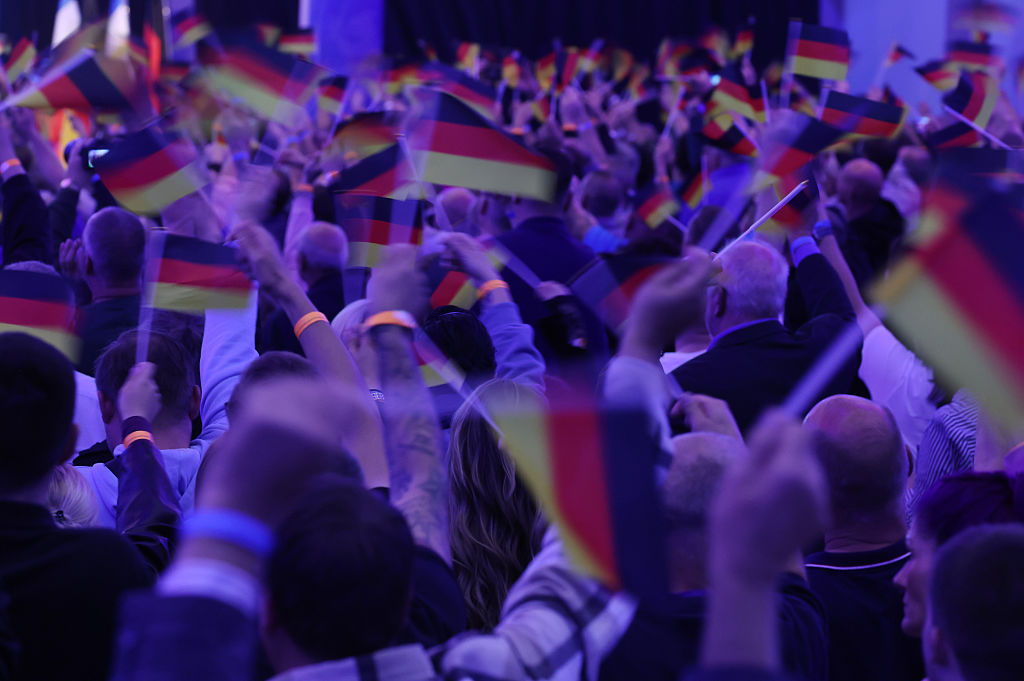
Alternative for Germany (AfD) has won the most votes in northeastern Germany, marking the far right party’s second first-place result in state elections this year. The AfD won 38.2% of the votes in the state of Mecklenburg-Western Pomerania on Sunday, according to preliminary official counts. It was followed by the center-left Social Democratic Party (SPD) with 35.5%.
The results add onto the AfD’s earlier success in the eastern state of Saxony-Anhalt, bringing the party closer to regional power than any far-right party since WWII. Sunday’s results were a significant blow to the Christian Democratic Union (CDU), the mainstream conservative party of German Chancellor Friedrich Merz. The CDU won just 4.9% of the vote in Mecklenburg-Western Pomerania, its lowest ever result in any state election and below the 5% threshold needed to enter state parliament.
Without an outright majority, the party would need support from lawmakers outside its ranks to govern, but mainstream political parties in Germany maintain a “firewall” against the AfD. Merz has also vowed to stay on and continue his reform agenda, bucking speculation that he might resign. In Mecklenburg-Western Pomerania, state party co-chairs Leif-Erik Holm and Enrico Schult, together with secretary general Dario Seifert, led the AfD’s campaign.
Like the national party, the state organization ran on a hard-line anti-immigration platform, calling for more deportations, a state border and deportation police force, and potentially a statewide halt to accepting asylum seekers. The party also promised to stop further wind power development, lower property-transfer taxes, and reduce the size of the state administration. It also proposed withdrawing from the interstate broadcasting treaty as part of an effort to overhaul public broadcasters.
Holm said his goal was an AfD-only state government, but he softened towards the end of the campaign and expressed openness to coalition discussions with any other party. But while CDU state leader Daniel Peters previously said there was effectively no longer a firewall against the AfD in eastern Germany, the SPD, Greens and Die Linke—the three other parties elected to the state parliament in Sunday’s election—have thus far rejected cooperation with the AfD. The SPD came second in the state after Manuela Schwesig, state premier since 2017, propelled the party to a late surge in polls.
Schwesig cast herself as a bulwark to an AfD government, while also criticizing the federal government’s reform agenda. The CDU, alongside its sister party in Bavaria the Christian Social Union (CSU), is in a governing coalition with the SPD at the federal level. Asked by broadcaster ARD why around 45,000 former SPD voters had switched to the AfD, Schwesig cited dissatisfaction with the federal government and growing opposition to Germany’s financial and military support for Ukraine.
Extract — continue reading at the source.