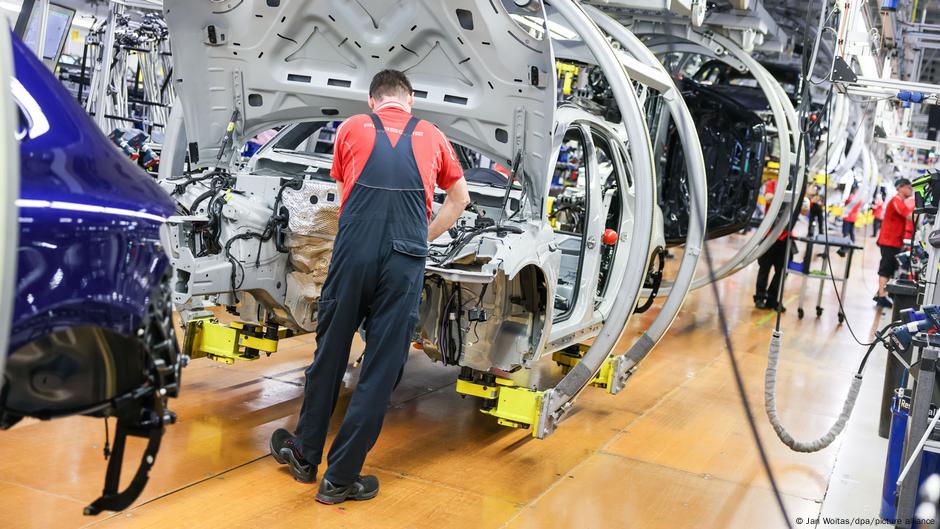
Germany's famed automotive sector is facing a deep crisis, squeezed by high manufacturing costs, punitive US tariffs, intensifying competition from China and a difficult transition to electric vehicles. Industry heavyweights such as Volkswagen, Mercedes-Benz and BMW have announced plans to scale back production and reduce costs. The branch is shedding jobs faster than any other industrial sector in the country.
Volkswagen, for instance, is looking to cut about 15% of its workforce worldwide, or 100,000 jobs, by the end of the decade. BMW announced it will cut up to 8,000 jobs — about 5% of its workforce — by the end of 2027. Auto suppliers such as Bosch and ZF Friedrichshafen have also announced thousands of job reductions amid tough market conditions and global competition.
To view this video please enable JavaScript, and consider upgrading to a web browser that supports HTML5 video Germany's automotive industry is losing competitiveness as costs rise and production shifts abroad, said Ferdinand Dudenhöffer, director of the Center for Automotive Research (CAR) in the German city of Bochum. "In 2018, the industry employed around 830,000 people. Currently, that number is below 700,000," he told DW.
"We project that by around 2030, it will be 500,000." Regaining competitiveness and securing jobs in the future will require an array of measures including lower production and energy costs, better logistics infrastructure and favorable tax conditions, he added. Auto industry executives agree that labor costs in Germany are too high compared to international rivals. Labor costs in the country average $3,307 (€2,882) per vehicle, compared to $769 in Japan and $597 in China, according to a reportpublished by the consulting firm Oliver Wyman.
To trim labor costs, carmakers want employees in Germany to work 40 hours a week instead of the current 35 hours, without any increase in pay. The 35-hour workweek has long been standard across much of Germany's automotive industry, having emerged from collective bargaining agreements negotiated in the 1980s and 1990s. It reflects an era when Germany was highly competitive, said Dudenhöffer, adding: "That time is over." Workers' unions, however, vehemently oppose longer working hours.
Christiane Benner, the head of the influential IG Metall trade union, said workers had already accepted wage cuts and other concessions worth several billion euros, yet were now being told that this was still not enough. The union argues that German automakers are struggling with weak demand and underutilized factoriesnot a shortage of labor hours. "Not a single additional car will be sold just because the workforce works longer hours," the union announced.
Extract — continue reading at the source.