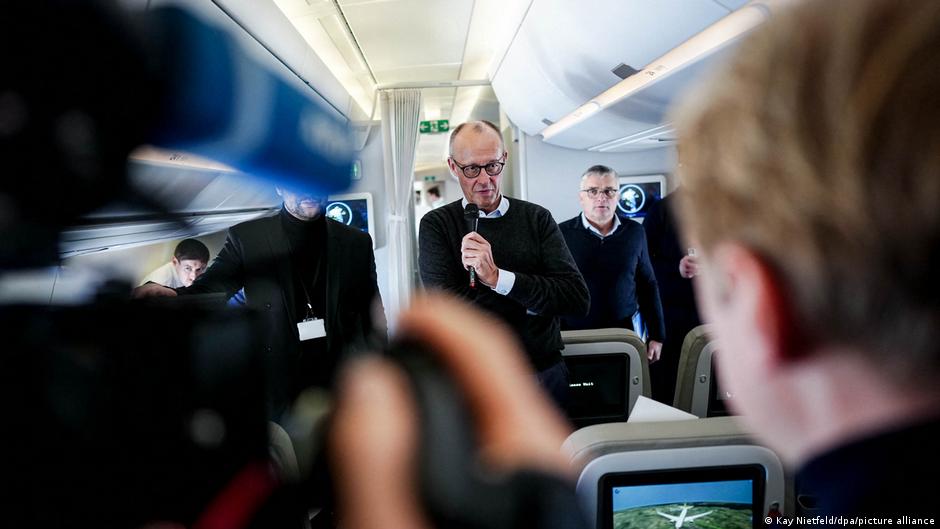
German Chancellor Friedrich Merz kicked off a five-day tour of Asia on Monday, traveling to Singapore before his scheduled visits to Japan and South Korea. Merz is accompanied by an entourage of 30 senior businesspeople, including representatives of Germany's industry, tech and defense companies, and energy suppliers. At the same time, Germany's President Frank-Walter Steinmeier is visiting China.
While the trips are not officially related, they both seem aimed at boosting Berlin's economic and security relationships at a time of geopolitical instability, which threatens global supply chains. In Singapore, Merz is set to deliver a major foreign policy speech and meet Prime Minister Lawrence Wong. He will then travel to Japan on Wednesday to meet with Prime Minister Sanae Takaichi and take part in the German-Japanese Business Summit.
Merz's visit "will be very much welcomed in Tokyo," said Ben Ascione, an assistant professor of politics and international relations at Tokyo's Waseda University. "For more than a decade, Japan has been looking to generate new security allies and closer trade partnerships," he told DW. To view this video please enable JavaScript, and consider upgrading to a web browser that supports HTML5 video "This greater outreach was started under Prime Minister [Shinzo] Abe, but Takaichi is very much following that blueprint because of the growing tensions in the Indo-Pacific region and the greater uncertainty around the second administration of [US President] Donald Trump," he added.
The challenges posed by an increasingly expansionist China in the region are of deep concern to Tokyo, particularly as Beijing is forging closer ties with both Russia and the unpredictable regime in North Korea. China and Russia have conducted joint military exercises off Japan, and Beijing is resolute in its insistence that Taiwan be brought under the control of the mainland. Ascione points out that any conflict over Taiwan, the disputed islands of the South China Sea or territorial claims elsewhere in the region would have a major impact on global trade.
Such disruptions would also impact Germany. "Japan and Germany have different primary security threats at the moment, with Germany focused on the Russian invasion of Ukraine and Japan keeping a close watch on China, North Korea and Russia, but I do believe that Germany has come more into line with Takaichi's perception of the security threat that is posed by China," Ascione said. "Takaichi is going to underline the importance of a rules-based order and the policy of a free and open Indo-Pacific at a time of such geopolitical uncertainty," he added.
"Japan has in recent years moved towards greater resilience building, supply chain resilience and more and deeper security partnerships." According to Ascione, Japan would also "welcome" Germany deploying its military assets to the region, following its Bayern frigate docking in Tokyo in 2021 and its fighter jets conducting air drills with Japanese fighters in 2024. The frigate Bayern became the first German Navy warship to dock in Tokyo in 20 years in May 2021 and went on to conduct air and maritime exercises with Japanese units. In July 2024, German Eurofighter Typhoon aircraft similarly carried out air drills with Japanese fighters over northern Japan.
Extract — continue reading at the source.