Recent cross-sectional studies have reported associations between gut microbiota and cognitive function in older adults. However, this relationship has not been explored in Okinawa, Japan, a region historically recognized for exceptional human longevity. In this cross-sectional study, we recruited 155 community-dwelling adults aged 65 or older from Okinawa Prefecture, Japan.
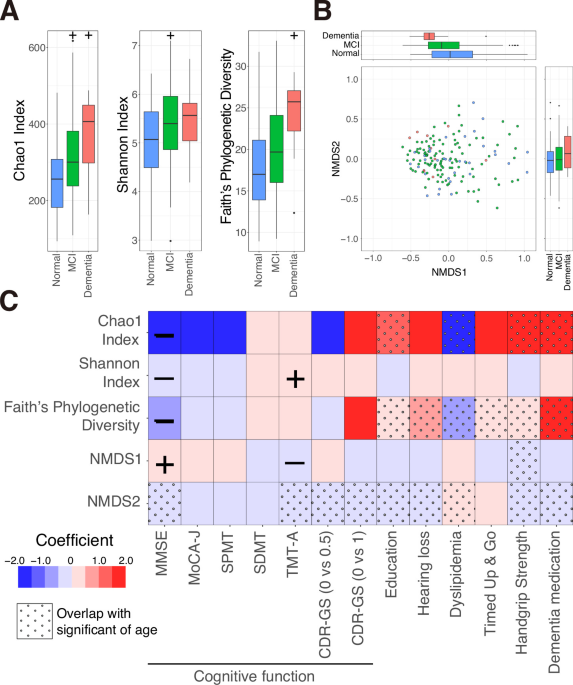
Participants underwent comprehensive neuropsychological assessments and were classified as cognitively normal, having mild cognitive impairment (MCI), or having dementia, based on Montreal Cognitive Assessment-Japanese version (MoCA-J) and Clinical Dementia Rating (CDR) scores. We analyzed their gut microbiota using 16S rRNA gene amplicon and whole-genome shotgun sequencing. We found that both gut microbial alpha diversity and community structure were significantly associated with cognitive status and performance scores.
Species-level analysis revealed that Fusicatenibacter saccharivorans, an anti-inflammatory bacterium, was positively correlated with the cognitive performance score and co-occurred with Faecalibacterium prausnitzii, a species that ameliorates cognitive impairment in an Alzheimer’s disease mouse model. Conversely, the mucin degradation pathway, indicative of mucosal barrier dysfunction, was enriched in the MCI group. In summary, our findings provide insight into microbial and functional signatures associated with cognitive performance in older adults.
Further longitudinal studies, replication studies in independent cohorts, and experimental validation are needed to confirm these findings. Dementia is a progressive neurodegenerative disorder characterized by cognitive decline that impairs memory, reasoning, and daily functioning1. With the rapid global aging of populations, its prevalence continues to increase2, yet effective therapeutic options remain limited3,4, posing a major public health challenge5.
An epidemiological study estimated that approximately 50 million people were living with dementia in 2019, and this number is expected to exceed 150 million by 20506, highlighting the substantial physical, psychosocial, and economic burden on individuals and society. In Japan, which has one of the most rapidly aging populations in the world, dementia has been recognized as a leading cause of death since 20157, emphasizing an urgent need for preventive strategies. Mild Cognitive Impairment (MCI) represents a transitional stage between normal aging and dementia, characterized by impaired cognitive abilities that do not significantly interfere with daily life8.
Numerous population-based studies estimate that approximately 15–20% of adults over the age of 60 exhibit MCI, and that 8–15% of those individuals progress to dementia annually9, highlighting the importance of early detection and intervention. Recent cross-sectional studies in older adults have explored the gut-brain axis, revealing associations between gut microbiota and cognitive function. Anti-inflammatory bacteria have consistently been linked to better cognitive performance10,11,12,13,14.
Extract — continue reading at the source.


