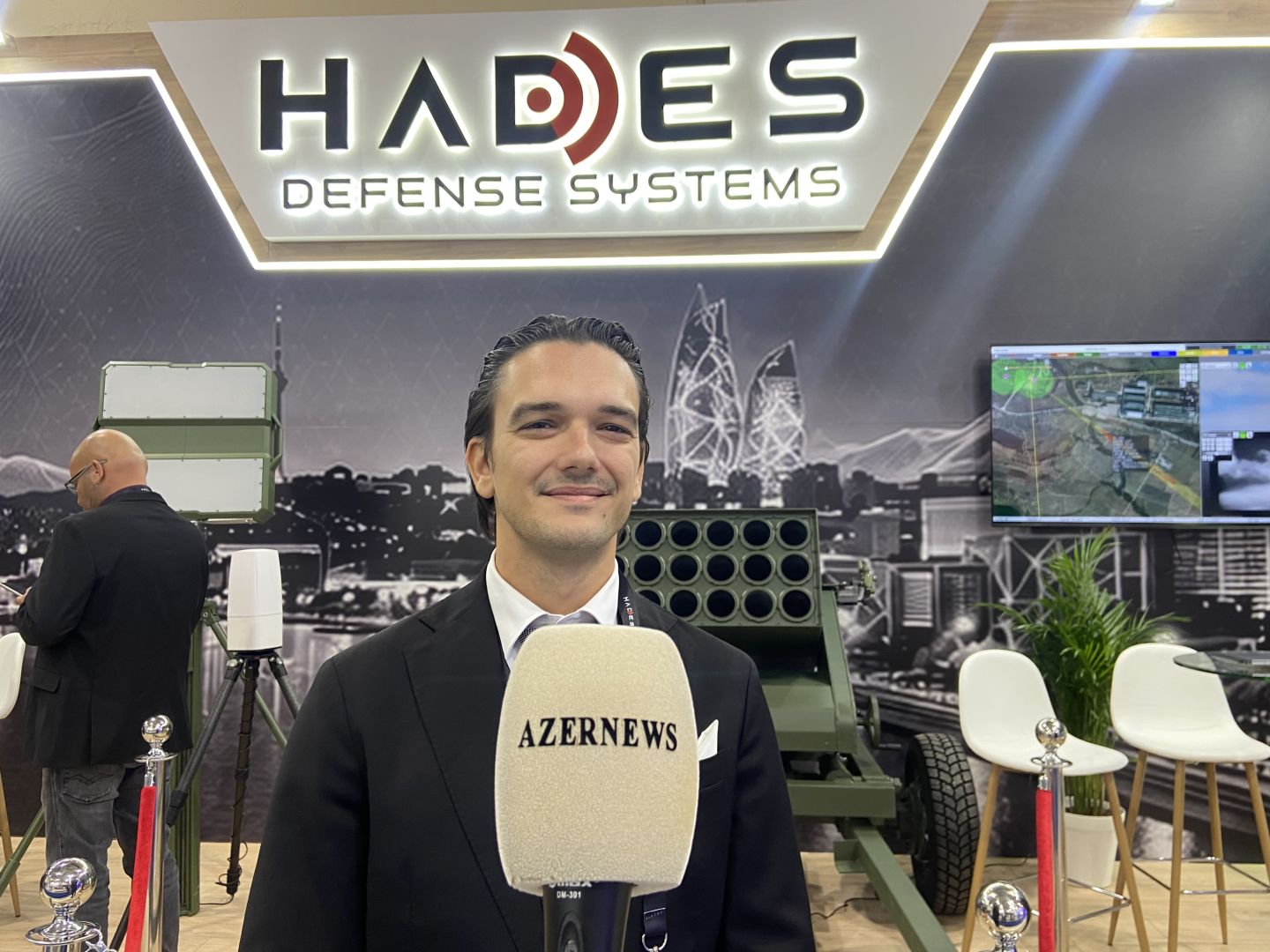
The rapid evolution of drone warfare is forcing defense companies to rethink not only how unmanned aerial vehicles are detected and intercepted, but also how much it costs to destroy them. Speaking to AzerNews on the sidelines of ADEX 2026, HADES Defense Systems delegate Georgio Markov outlined the company’s approach to counter-UAS technology, its interest in the Azerbaijani market and the prospects for localization and cooperation with the country’s defense industry. According to Markov, HADES has built its counter-drone concept around a multi-layered architecture combining different detection and interception technologies, with particular emphasis on hard-kill capabilities.
Now, I would say that the main difference which actually makes us more capable of dealing with such threats is, of course, that we put an extreme emphasis on the hard-kill aspect,” he told AzerNews. The growing autonomy of military drones has made reliance on electronic warfare alone increasingly problematic, he argued. But they are useful, they have their place, don’t get me wrong, but you cannot rely fully on jamming systems,” Markov said.
For HADES, the answer lies in ensuring that electronic countermeasures are complemented by a physical means of destroying an incoming UAV. Yet physically destroying drones creates another challenge that has become increasingly apparent in recent conflicts: economics. Relatively inexpensive UAVs can force militaries to expend interceptors costing many times the value of the target.
Markov said HADES has therefore made reducing the cost of each interception a central consideration in the development of its systems. And when you do the math, the total just doesn’t add up.” He said the company’s approach is consequently centered on providing a relatively inexpensive final layer of defense capable of permanently neutralizing an incoming threat. Beyond counter-UAS technology, HADES sees potential for expanding its presence in Azerbaijan.
Markov said the company has already received interest from the Azerbaijani market, particularly concerning its expertise in rocket systems. We have had some interest from the Azerbaijani market. Mostly, it seems to be focused on our expertise in the rocket systems,” he said.
At ADEX 2026, the company is placing particular emphasis on multiple launch rocket systems, or MLRS, rocket artillery and radar technologies. I mean, this time around, we’re primarily focused on MLRS rocket artillery systems and radars,” Markov said. Counter-UAS radars represent another area where he sees considerable potential.
Extract — continue reading at the source.