Parkinson’s Disease (PD) is a neurodegenerative disorder that affects older individuals, especially in aging countries like Japan. A key symptom of PD is hand tremor, which impairs fine motor skills, including handwriting. Early detection is crucial for treatment and management.
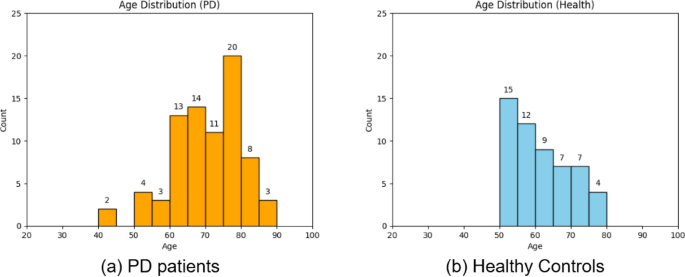
However, existing datasets often lack sufficient task variety for effective, computer-aided PD recognition. To address this, we propose the HandPD37 dataset, which includes handwriting samples from 78 PD patients and 54 healthy individuals across 37 tasks. These tasks assess both fine motor skills and linguistic complexity, capturing diverse handwriting characteristics indicative of PD.
Data was recorded using tablet devices, providing detailed information like X–Y coordinates, pen pressure, and time stamps. Additional kinematic features, such as speed and acceleration, were extracted, totaling 171 features per sample. We applied a stack ensemble of 10 machine learning (ML) algorithms, with Logistic Regression (LR) for classification, and evaluated the tasks using a meta-ensemble approach.
Tasks 18, 28, 33, and 34 were most effective for distinguishing PD patients from healthy controls. The results demonstrate that combining kinematic and pressure-based features with ML models improves PD recognition accuracy. The HandPD37 dataset and ensemble approach provide a promising solution for clinical decision-support for PD diagnosis.
The 37 tasks, tailored for Japanese participants, enhance the dataset’s applicability for more accurate and generalized PD detection. Parkinson’s disease (PD) is a complex neurodegenerative disorder that affects millions of people worldwide1,2,3,4,5. Current estimates suggest a prevalence ranging from approximately 10 to 800 cases per 100,000 individuals, making PD one of the most common neurodegenerative diseases6.
The condition primarily affects motor function and is typically associated with resting tremor, muscle rigidity, bradykinesia (slowness of movement), and impaired postural reflexes. These motor symptoms are closely related to deficits in motor planning, programming, sequencing, initiation, and execution of movements7. At present, there is no fully objective clinical test for diagnosing PD.
Extract — continue reading at the source.


