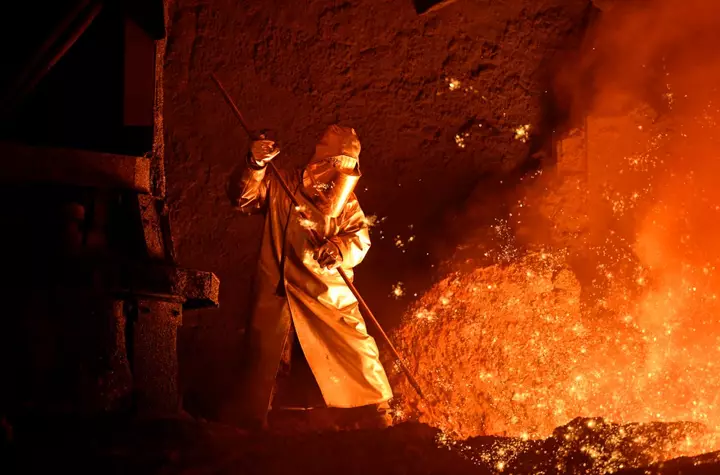
The iron and steel industries are among the biggest polluters in the world. Plenty of startups have tried to cut the industry’s emissions, mostly by developing new ways to make the metals. Helix Carbon thinks those startups have been going about it all wrong.
A blast furnace is the giant furnace that turns iron ore into the iron used to make steel. Rather than replace blast furnaces, Helix wants to clean them up. Its approach promises to slash the steel industry’s carbon emissions while boosting profit margins for iron producers, a rare win-win for a dirty industrial process.
Blast furnaces have made iron for centuries, using coke, a processed form of coal, to help turn raw iron ore (iron bound up with oxygen) into metallic iron. The burning coke supplies heat for the reaction but doesn’t take part in it directly. Instead, carbon monoxide produced from the combustion does the work of reducing the iron, meaning stripping away its oxygen atoms.
The process releases tremendous amounts of carbon dioxide, or CO2, which is normally dumped straight into the atmosphere. But Helix Carbon has devised a way to turn that waste carbon dioxide into carbon monoxide and recycle it back into the blast furnace. Helix Carbon’s process relies on an electrolyzer, a device that uses electricity and a catalyst to break off an oxygen atom from the carbon dioxide.
Electrolyzers aren’t new, but Brown said the startup’s design can handle the entire exhaust stream from the blast furnace. Most electrolyzers are too delicate for raw exhaust like that. They work only on purified, concentrated carbon dioxide, so the exhaust typically has to be processed before they can use it.
By injecting carbon monoxide into a blast furnace, iron producers can use less coke. How much, exactly, is still debated, Brown said. Some scientific papers suggest as much as 90% of the coke can be eliminated, while other studies suggest it’s more like 30% to 40%.
Extract — continue reading at the source.