This story has been updated from a story first reported in August. This midterm cycle, the Trump administration has gathered millions of state voter records for law enforcement purposes, endeavored to restrict mail-in voting nationwide, declined the typical practice of inviting international election observers and repeatedly raised the idea of dispatching armed federal personnel to voting locations. The Trump administration broadly describes its actions as an effort to ensure the integrity of the American democratic system after the president's signature election overhaul effort, the SAVE America Act, foundered in the GOP-led Senate.
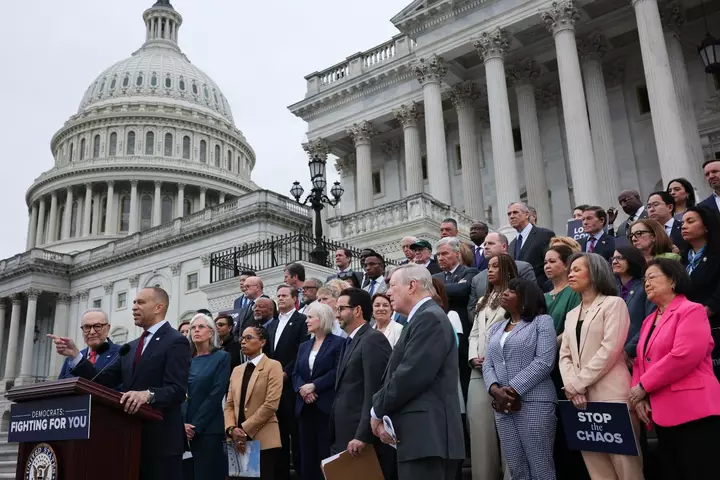
In a statement to NPR in October, White House spokeswoman Lauren Bis said that "President Trump has done more than any other President to ensure we have free and fair elections. While extreme Democrats and the media continue to dismiss concerns about voter fraud, the Trump Administration is taking decisive action to protect our elections including prosecuting election crimes, strengthening election infrastructure security, and protecting vulnerable voters from fraud and coercion." This summer, NPR spoke to more than a dozen people who've formed what they describe as an election protection task force. It's a coordinated effort between Democratic lawmakers and their staffers, election litigators, scholars and nonpartisan good governance organizations.
Those involved worry that the administration will point to normal, but poorly understood, parts of American election infrastructure, including slow vote counting in California and Alaska, as evidence of fraudulent behavior. They also say that the administration has long worked to undermine public trust in a secure and transparent election system and has, without constitutional authority, inserted the executive branch into the state-led election process. Democracy Forward — a legal nonprofit that says it works to advance democracy and social progress through litigation, policy and public education — has written that the Trump administration's efforts "harness the president's longstanding and baseless conspiracy theories in pursuit of discovering so-called 'election fraud.' These actions are reckless and run the risk of intimidating and disenfranchising voters." Even as task force members acknowledged there is no magic "protect democracy" button tucked away in a Capitol cloakroom, they each emphasized the power of legislators as messengers and organizers.
Their primary goal is to to prepare the public and their state and local counterparts to act when necessary to ensure election results are honored. "We have very important elections coming up," Trump said in a July address from the East Room of the White House. "We want those elections to be honest." He used the speech to call on Congress to pass the SAVE America Act, which would, among other measures, require voters to show proof of citizenship when registering to vote and a photo ID before they can cast a ballot.
"How easy is that to do, unless you want to cheat? The only reason you wouldn't do it is you want to cheat because your policies are so bad, and your candidates are so pathetic that you can't get away or can't get elected any other way," he said. Members of the Democratic task force said the remarks should be understood as an effort to make voter fraud — which studies and investigations have found to be vanishingly rare — seem plausible.
Justin Vail, a leader at Protect Democracy, a cross-ideological group that says it uses litigation, advocacy and research to protect American elections is a member of the task force. He previously served as a special assistant to President Joe Biden, working on democracy issues. He told NPR that Trump's speech was an effort to sow doubt in November's elections, a first step in what his organization characterizes as a three-step playbook: deceive, disrupt and deny.
Extract — continue reading at the source.