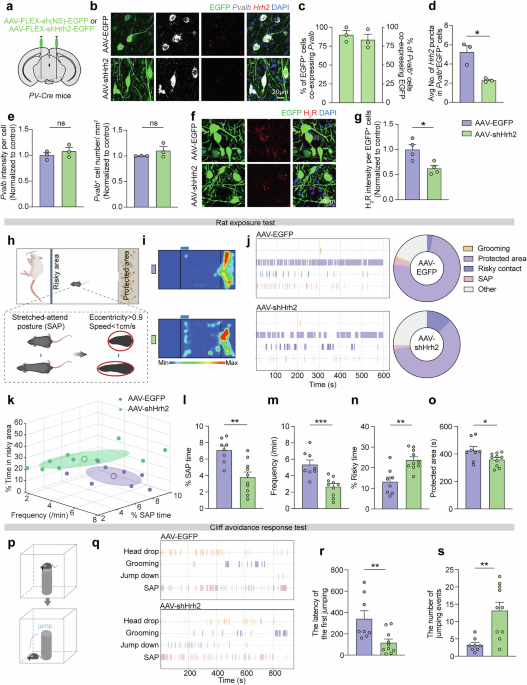
Risk-taking is frequently observed in psychiatric conditions such as attention-deficit hyperactivity disorder, yet the neuronal mechanisms underlying this behavior remain unclear. Here, we show that histamine H2 receptor (H2R) in parvalbumin-positive neurons (PV+) of the substantia nigra pars reticulata (SNr) bidirectionally regulates risk-taking behaviors. Dysfunction of superior colliculus-projecting SNr PV+ neurons contributes to the increased risk-taking caused by H2R deficiency.
Moreover, H2R deficiency promotes risk-taking behavior by altering PV+ neuronal dynamics during risk assessment in an H2R-dependent manner. Pharmacological activation of H2R in the SNr rescues excessive risky exploration in dopamine transporter heterozygous mutant mice (DAT+/-), a well-established mouse model of attention deficit hyperactivity disorder (ADHD)-like phenotypes with increased risk-taking behavior. Collectively, these findings demonstrate that H2R deficiency in SNr PV+ neurons drives risk-taking execution by disrupting the function of PV+ neurons and their downstream projections in mice.
It may enhance the understanding of the neural mechanism underlying threat-related risk-taking and highlight H2R as a potential therapeutic target for pathological risk-taking behavior. This is a preview of subscription content, access via your institution Receive 12 print issues and online access Prices may be subject to local taxes which are calculated during checkout All data supporting the findings and conclusions of this study are presented in this paper and the supplementary materials. Additional data related to this study are available from the corresponding authors upon reasonable request.
All data reported in this paper will be shared by the lead contact upon request. This study did not generate original code. Additional information required to reanalyze the data reported in this study is available from the lead contact upon reasonable request.
Rangel A, Camerer C, Montague PR. A framework for studying the neurobiology of value-based decision making. Nat Rev Neurosci. 2008;9:545–56.
Article CAS PubMed PubMed Central Google Scholar Namimi-Halevi C, Dor C, Dichtiar R, Bromberg M, Sinai T. Attention-deficit hyperactivity disorder is associated with risky and unhealthy behaviours among adolescents. Public Health. 2024;237:51–56.
Extract — continue reading at the source.


