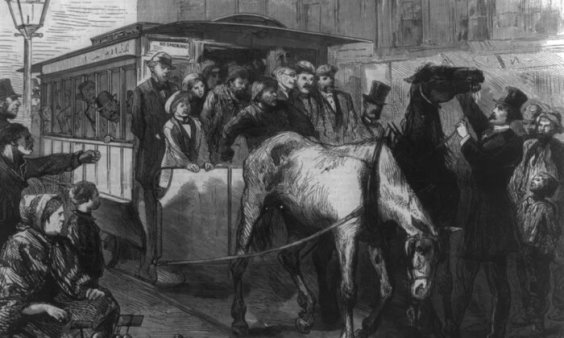
This article was adapted from “Nary a Horse Left Standing,” by Lee Alan Dugatkin, published by The MIT Press. It was reprinted with permission from MIT Press Reader. On Wednesday, October 23, 1872, a slew of articles appeared in The New York Times, The New York Herald, and The New York Sun, warning New York citizens that their city was in dire straits.
In what must have struck New Yorkers like a thunderclap, the Herald ran a huge story titled “THE EPIZOOTIC,” in which readers cast their eyes on a sub-headline of “Seven Thousand Horses in the City Stricken with Catarrhal Fever During the Past Twenty-Four Hours,” followed by sub-sub-headlines of “Millions of Dollars in Horseflesh at Stake” and “How the Disease Will Affect Local Traffic and Travel.”The reporter who penned the story began by assuring his readers that though what they were reading would seem almost impossible to believe, it was all too true. He had personally visited “all the principal stables in the city,” and, if anything, the seven-thousand figure in the headline was an underestimate. No one’s horse was safe: From the “squalid shed that shelters the costermonger’s nag to the magnificent palace where the millionaires’ thoroughbreds recline at their ease, surrounded by all the luxury that wealth can purchase,” horses were falling ill at an alarming rate.
Read more: “Did Cars Rescue Our Cities from Horses?” In a city where so many relied on horses directly and indirectly for their daily keep, sick animals were forced onto the streets to pull streetcars, deliver merchandise, pull fire carts, and more. Some questioned the wisdom of such actions from a moral and economic perspective. Arguably, chief among them was Henry Bergh, the founder of the Association for the Prevention of Cruelty to Animals (ASPCA), who did everything he could to help those sick horses.
A native New Yorker, whose father had been a shipbuilder often employed by the U.S. government, Bergh was portrayed as “a tall, elegant figure [with] a high forehead, on which a single lock curls gracefully down in the Ciceronian style ... his otherwise classical features are modernized by a moustache.” In 1862, he was appointed Secretary of the Legation in St. Before he assumed that position, one historian of the animal rights movement described Bergh as “a cultured swell who had previously expressed only modest public-mindedness.” Bergh’s outrage at animal cruelty seems largely to have been born in 1863, after witnessing a Russian carriage driver beating his fallen horse. Bergh stepped in to protect the unprotected, and from that time on, the Times reported many years later, “[he] began there that active interference on behalf of the rights of animals to kind treatment which has earned for him a worldwide reputation.” The following year, Bergh resigned his post in Russia for health reasons and, on his return to America, stopped in Europe for an extended visit.
While he was in England, he met and befriended Dudley Ryder, Second Earl of Harrowby, who was serving as president of the Royal Society for the Prevention of Cruelty to Animals. Ryder was more than happy to work with Bergh on plans to create an American version of his beloved RSPCA. The coming-out party for the nascent ASPCA was a February 8, 1866 lecture that Bergh presented to the American Geographical and Statistical Society in lower Manhattan.
While Bergh prepared for the meeting, he had drafted a short petition, considered the founding document of the ASPCA: Patrons of a Society Proposed to be Founded for the Prevention of Cruelty to Dumb Animals The undersigned, sensible of the cruelties inflicted upon dumb animals by thoughtless and inhumane persons; and desirous of suppressing the same—alike from considerations affecting the moral well-being of society, as well as mercy to the Brute creation: consent to become patrons of a Society having in view the realization of these objects. By the time Bergh stood up to speak at the American Geographical and Statistical Society, this document had already been signed by the New York City mayor, John T. Hoffman, along with former U.S.
Extract — continue reading at the source.