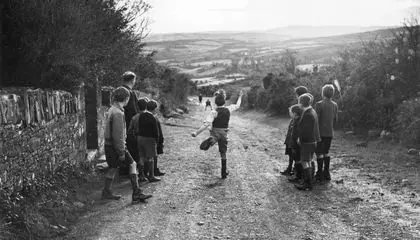
On a rural backroad in West Virginia one might come across an unusual sign, stenciled in block letters: “Slow Please, Irish Road Bowling Ahead.” Somewhere up the road, a player takes a running start and heaves a solid 28-ounce iron ball about the size of a baseball, underhanded, down the asphalt. Spectators track the sphere with their eyes—some are quite invested, with money riding on where it lands. The West Virginia Irish Road Bowlers then take turns to try to cover the course of 1 to 2.5 miles in the fewest throws.
If this sounds familiar, it may be because the retired football star Jason Kelce recently took a swing at the sport for ESPN with the Boston Road Bowling team, a squad mostly composed of Irish expats. Their brogue was the star of the show: “I played two matches, lost one won one, and struggled to understand at least 50 percent of what was said,” wrote the retired NFL star on Instagram, before vowing to try the sport again. A post shared by Jason Kelce (@jason.kelce) A deeply rooted Irish tradition, road bowling might seem a little archaic: In matches, or scores, teams take turns hurling a small cannonball down a course, while others watch from the sidelines.
In Ireland, there’s now a campaign underway to include it in the UNESCO Intangible Cultural Heritage list. And the game is gaining traction stateside. The sport asks for little more than a ball—called a bullet, or a bowl—and a road, and West Virginia has plenty of both, plus its own road bowling history.
Dan Harvey, an Irish military historian, concluded that troops of Irish origin most likely bowled on the streets of West Virginia, passing time between battles during the Civil War. Since then, the sport lay dormant in the region, until about 30 years ago, when it was revived by environmental journalist and documentary producer David Powell. These days, thanks in major part to evangelist Powell, and to the visuals afforded by social and traditional media, it has become part of the state’s identity.
Powell, of Scotch-Irish descent, first discovered it on television. In 1994, on a trip to Cork, Ireland, with his mother, he bought six bullets at a hardware store and later sent away for nine more. A year later he debuted the sport at the Irish Spring Festival in, poetically, Ireland, West Virginia, the tiny town where his mother happened to hail from.
At first, people kept their distance. Then a family of boys came out to play, along with a father in a wheelchair, recovering from a tobogganing accident. He contacted the road bowling team in Boston—the same one that played with Kelce, established in 1996 as the first road bowling team stateside, and known for its championship-winning bowling skills.
Extract — continue reading at the source.