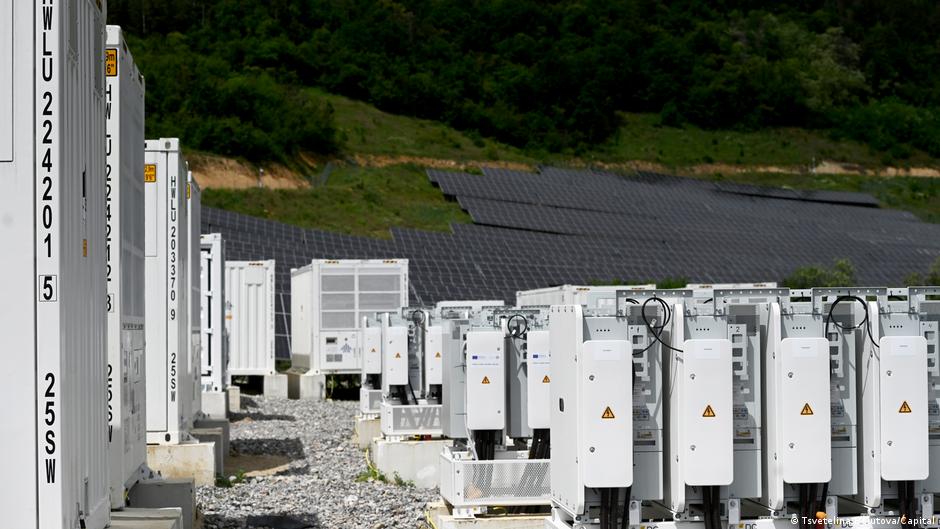
The international energy sector currently has a curious case study in an unlikely place: Bulgaria, a country in southeastern Europe with a population of just 6.4 million, now has one of the world's highest ratios of battery storage to total power capacity, outpacing markets like California, Germany and China. In less than two years, Bulgaria's battery storage capacity has gone from zero to making up nearly a quarter of the country's total installed power capacity, fueled by EU funding and private capital worth close to €3 billion ($3.4 billion), according to calculations by Bulgaria's leading business publication Capital. Bulgaria was lucky enough to escape the worst of the heatwaves and droughts that forced a cut in nuclear and hydro output in Hungary and Romania this summer.
During that period, it turned its batteries into a key grid stabilizer for neighboring markets and profited by storing cheap solar power and selling it in the evening when prices spike. And while experts say the Bulgarian battery boom went "under the radar," it remains to be seen how this rapid development will affect the other generators of power, whether the current business model is sustainable and whether private investment will dictate a shift in the national strategy for the country's energy transition. In January 2026, a report by the energy think tank Ember estimated Bulgaria's battery capacity — both operational and in the pipeline — to be 1.66 GW.
Eight months later, capacity had more than tripled to 5.4 GW, according to data from ENTSO-E. Bulgaria's Ministry of Energy told it had already reached 5.7 GW. "Two years ago, no one imagined we would have even half of this capacity," Ivaylo Stanchev, editor-in-chief of the business publication Capital, told DW.
Stanchev compiled one of the country's most comprehensive lists of battery projects, filling a gap left by the absence of an official public database. The list itself reflects investment levels that have outpaced official forecasts. While the rapid battery buildout was sparked by the Next Generation EU recovery fund and the subsequent RESTORE programs, which approved €700 million ($797 million) in funding for 113 projects, Stanchev estimates that private investment amounted to almost three times that figure: roughly €2 billion.
Although most of the lithium batteries come from China, the investors are mostly from Bulgaria or from other European countries, which see potential in the growing niche. "When fully charged, the batteries can store enough energy to power the whole country for several hours," said Stanchev, drawing a comparison that, although practically impossible, illustrates the scale of the development. Its effects are already tangible: Bulgaria produces a large amount of solar energy and buys more from Greece and Romania.
Daily prices during the summer tend to be low or even negative during the sunniest hours of the day, allowing batteries to buy cheap energy, store it and discharge it in the evening, when local and international markets need it, at a higher price. The main export destination is Romania, which was particularly badly hit during the summer as it had to reduce nuclear capacity because of the drought along the Danube. Bulgaria, historically a net exporter, has thus turned into a regional battery hub, with an operational storage capacity that is now greater than that of Greece and Romania combined.
Extract — continue reading at the source.