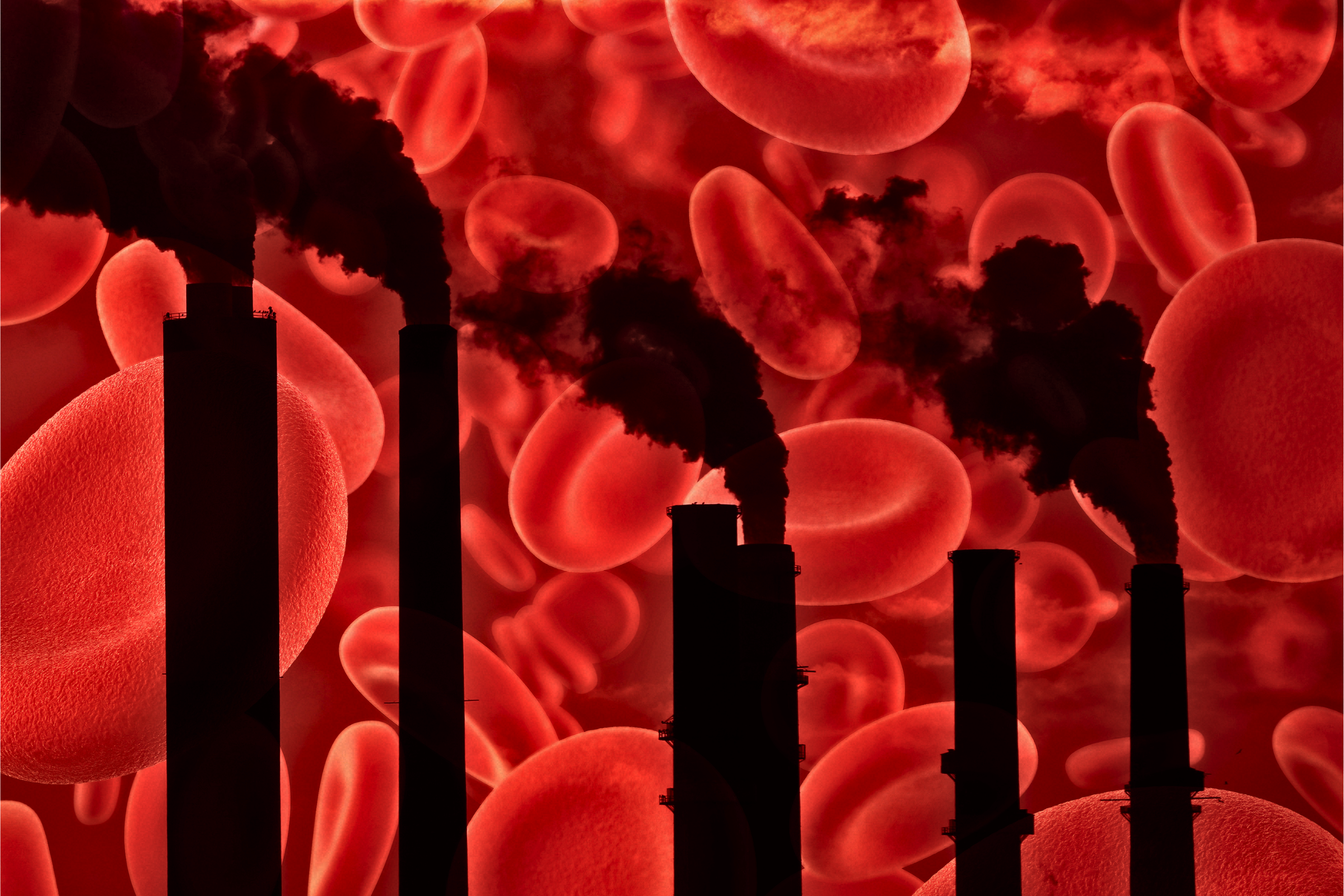
Rising carbon dioxide levels in the atmosphere do a lot of damage—heat waves, droughts, wildfires, superstorms. Now it appears there’s another knock-on effect that had never before been measured. According to a new study in the journal Air Quality, Atmosphere and Health, the changing chemistry of the atmosphere could be leading to changing chemistry in our blood—with potentially dangerous effects.
If CO2 is indeed messing with our blood, it’s no wonder. During the early rise of Homo sapiens, carbon dioxide levels in the atmosphere measured a consistent 280 parts per million (ppm). Those conditions prevailed until roughly the middle of the 18th century when the Industrial Revolution began pouring greenhouse gasses into the air from factory smokestacks.
By 1900, CO2 levels had risen to nearly 300 ppm; by 1980, that figure had jumped to nearly 330 ppm. Since then the numbers have exploded, standing at 425 ppm today. That’s very bad news for the health of the planet—and equally bad for the health of our bodies.
Every breath we take—indoors or out—draws in more carbon dioxide than our bodies were originally adapted to cope with. To determine just what the impact of this is, environmental geoscientist Phil Bierwirth, of Australian National University in Canberra, and environmental health scientist Alexander Larcombe, of the University of Western Australia, took advantage of a 21-year survey—from 1999 to 2020—conducted by the U.S. National Health and Nutrition Examination Survey (NHANES), during which government investigators sampled the blood of 7,000 subjects every other year to see how the body responded to all manner of environmental pollutants.
The period the NHANES researchers surveyed was a particularly bad one for the planet when it comes to carbon dioxide emissions, since in just those 21 years, U.S. CO2 levels rose from 369 ppm to 420 ppm. In their work, Bierwirth and Larcombe were looking for rising levels of serum bicarbonate, a chemical marker associated with rising levels of CO2—and they found just that, with a 7% jump in bicarbonate over the 21 years.
Much in the way oceans can become more acidic as they absorb more carbon dioxide, the same can be said for blood. Over longer periods, animal studies raise the possibility of oxidative stress, inflammation, tissue calcification in the kidneys and arteries, and effects on bone.” At the same time bicarbonate levels have been rising in the blood, calcium and phosphorus levels have been falling, the study found. In addition to producing higher levels of bicarbonate, the body responds to rising carbon dioxide by drawing CO2 molecules out of the blood and storing them in bones in the form of carbonate—an ion composed of one carbon atom and three oxygen atoms.
Extract — continue reading at the source.