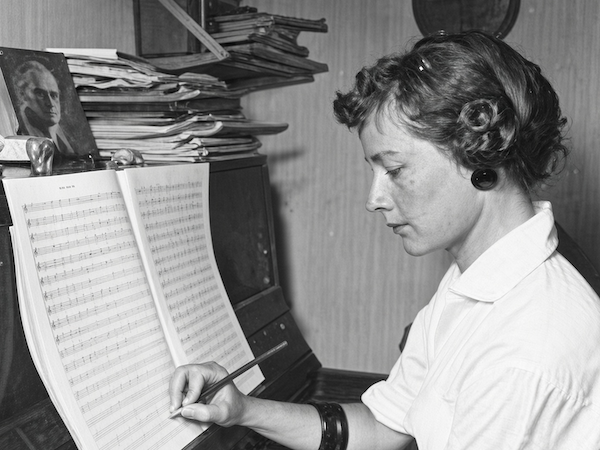
Before she became a composer of electronic music, Else Marie Pade was a sick child listening to the radio. Frequent kidney inflammations consigned her to bed for long periods of time, which would constitute neither her last nor her harshest experience of confinement. She was still young when the Nazis occupied her homeland of Denmark during World War II, and perhaps her youth explains her decision to spit on a column of marching German soldiers.
She escaped capture that day, running right into the Danish Resistance, for which she distributed underground newspapers and trained in the use of explosives to cut off the enemy’s telephone lines in the event of an Allied invasion. Arrested by the Gestapo in 1944, she never did get to execute that plan, but her real ambitions turned out to be much larger. And then I felt a strange calm: light, warmth and love were all around me.
This was the turning point in my life.” The very next day, “I started scratching staves on the prison wall with my garter belt fastener, and wrote out the theme that had come to me, inspired by the vision of the night.” Though infuriated at first, the Commandant in charge told her he would “make sure that the Red Cross brought me music paper and writing utensils so I would refrain from violence and would not dirty the wall any more.” Pade did all she could to compose during her time as a prisoner of war. After her transfer to the Frøslevlejren internment camp, she was reunited with her piano teacher Karen Brieg, who’d brought her into the Resistance in the first place. Though she entered the school with thoughts of becoming a pianist, a 1952 Danmarks Radio broadcast on Pierre Schaeffer’s musique concrète permanently changed the course of her artistic life.
Those sound collages turned musical experiences sent Pade back to her bouts of childhood sickness, during which her chief pleasures came from listening to the world around her. The result of this inspiration was the first work of electronic musique concrète composed in Denmark, A Day at Dyrehavsbakken. Learning from Schaeffer, and later from other electronic-music pioneers like Karlheinz Stockhausen, György Ligeti and Pierre Boulez, Pade developed the ability to realize the musical worlds she’s been exploring in her head all along.
Their austere soundscapes could hardly be farther from the sentimental schlager ballads she’d written to keep spirits up in the barracks, but as you can hear in the selection from 1985 to 1995 presented in the compilation above, the sonic imagination that heard an ambient symphony in dripping sponges, whistling kettles, singing birds, and trotting horses remains exhilarating today. Hear Seven Hours of Women Making Electronic Music (1938–2014) Daphne Oram Created the BBC’s First-Ever Piece of Electronic Music (1957) The Fascinating Story of How the Electric Music Pioneer Delia Derbyshire Created the Original Doctor Who Theme (1963) What is Electronic Music?: Pioneering Electronic Musician Daphne Oram Explains (1969) New Documentary Sisters with Transistors Tells the Story of Electronic Music’s Female Pioneers Hear Electronic Ladyland, a Mixtape Featuring 55 Tracks from 35 Pioneering Women in Electronic Music Based in Seoul, Colin Marshall writes and broadcasts on cities, language, and culture. He’s the author of the newsletter Books on Cities as well as the books 한국 요약 금지 (No Summarizing Korea) and Korean Newtro.
Follow him on the social network formerly known as Twitter at @colinmarshall. by Colin Marshall | Permalink | Comments (0) | We’re hoping to rely on our loyal readers rather than erratic ads. To support Open Culture’s educational mission, please consider making a donation. We accept PayPal, Venmo (@openculture), Patreon and Crypto!
Extract — continue reading at the source.