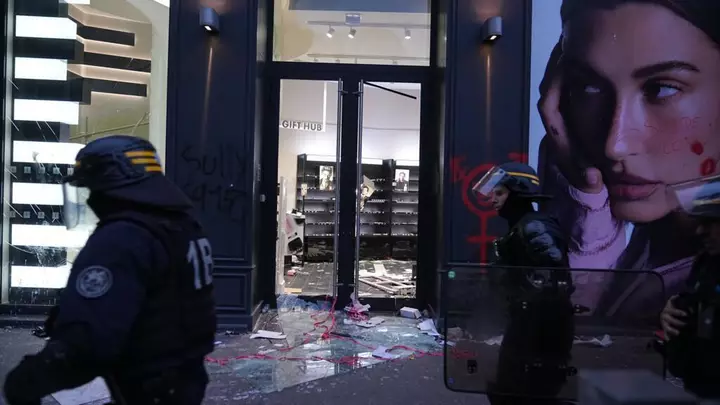
France's police striving to identify and arrest looters who shattered shops in last weekend's unrest are relying on one tool to trigger their forensic follow-up: social media. "We are working the social networks... then we go over all that with our own tools, to see if the crimes seen on social media correspond with the crimes we're studying," said an officer seated in a special operations room with 10 screens in front of him. To display this content from YouTube, you must enable advertisement tracking and audience measurement.
One of your browser extensions seems to be blocking the video player from loading. To watch this content, you may need to disable it on this site. Cover image: Des casseurs tentent de briser la vitrine d'un magasin Snipes près de Châtelet-Les Halles, le 18 octobre 2026. © AFP, Matthieu Rondel The officer, identified only by his first name, Bruno, was seated in a gamer-style chair, pushing a mouse around as looked closely at a video.
He said he was convinced he had identified a group of four youths who took part in the looting that had scarred Paris streets. Using street security cameras as well as cameras installed in the Paris region's transport system, Bruno tracked the four as they carried their haul, almost up to their home addresses. The officer was one of a dozen specialists carrying out similar digital hunts on screens in the cramped Security Operational Coordination Centre.
Read moreFrance faces reckoning with public order policing after violent protest weekend The team, at work since Monday, has 80,000 security cameras at its disposal, whose images it can tap into. Images on TikTok, Instagram, Discord and other social media platforms often provide the first clues. "Maybe a victim talks about a crime but doesn't go to the police station to report it– they're in shock, they wonder whether it's worth going– but they post it on social media," Bruno said.
"And so from that, we start checks, see about the geolocation... See if we can find the victim and if we can find the crime. If we find the crime, we send that to the criminal investigation unit, which takes over." Read moreFrench PM blames 'ultra-left' groups for weekend riots, promises 'massive' security deployment At that point, footage and footwork combine to potentially build a case.
A suspect identified "might say 'no, that's not me', but if we see their face in a video..." another officer in the unit said, implying that images were persuasive evidence. "It's not the only tool to close a case, but it's one of the very useful tools for investigators," she said. The process has already been used in other protest-related cases recently, such as in the assault of a trainee police officer in eastern Paris, or when a group of youths threw bricks from a chimney at police in the city.
Extract — continue reading at the source.