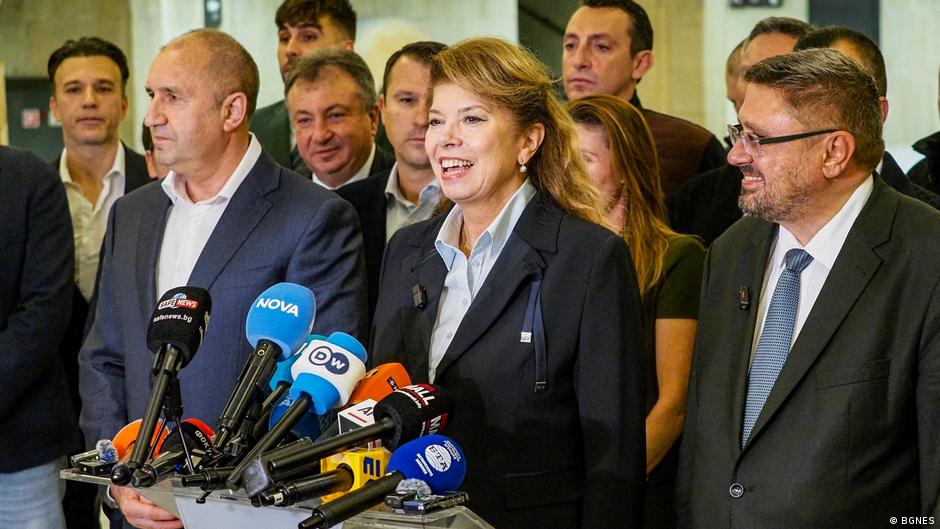
"We are choosing between war and peace," Bulgarian Prime Minister Rumen Radev told voters ahead of Sunday's presidential election runoff between incumbent President Iliana Yotova, who opposes military aid to Ukraine and favors dialogue with Russia, and former caretaker Prime Minister Andrey Gyurov, who is regarded as staunchly pro-European and pro-Ukrainian. With these words, it was clear that Sunday's runoff had turned into a kind of referendum on the country's foreign policy and stance on the war in Ukraine. Now that the official results are in and it is clear that Iliana Yotova won the election decisively by 57.6% to Gyurov's 39.5%, Radev claims that Bulgarians have chosen peace.
When the presidential election campaign began in Bulgaria on September 25, there did not seem to be any doubt about the outcome: Iliana Yotova was well ahead in the polls on 44.5%. Gyurov, her main rival, trailed far behind on 26.1%. Yotova was backed by both the prime minister and his ruling Progressive Bulgaria party, which won an absolute majority in the parliamentary election on April 19.
But the first round turned out to be much tighter than anticipated. While Yotova got 34.8% of the vote in the first round, Gyurov was close behind on 31.95%, which meant that a runoff between the two was necessary. While Yotova won the runoff convincingly, both the campaign and the outcome showed that the Bulgarian electorate is divided.
This division is both generational and geographical, explains Dimitar Ganev, sociologist and political scientist at the Trend market and electoral research agency. "Younger voters — those aged between 18 and 40 — favor Gyurov. Those over 40 tend to prefer Yotova," Ganev told DW.
"It also appears that Gyurov dominates in the capital, Sofia. In smaller regional cities, other towns and villages, Yotova dominates decisively," he said. This divide was also evident during the campaign.
While Andrey Gyurov relied mainly on social media for his campaign, Yotova chose to speak mostly to supporters of Progressive Bulgaria in closed venues. At such events, the war in Ukraine was always high on the agenda. "As long as I am president, and if you place your trust in me, not a single Bulgarian soldier will go to Ukraine," Yotova declared at an election rally on October 6 — even though according to the Bulgarian Constitution, only parliament (not the president) has the authority to send troops abroad or declare war.
Extract — continue reading at the source.