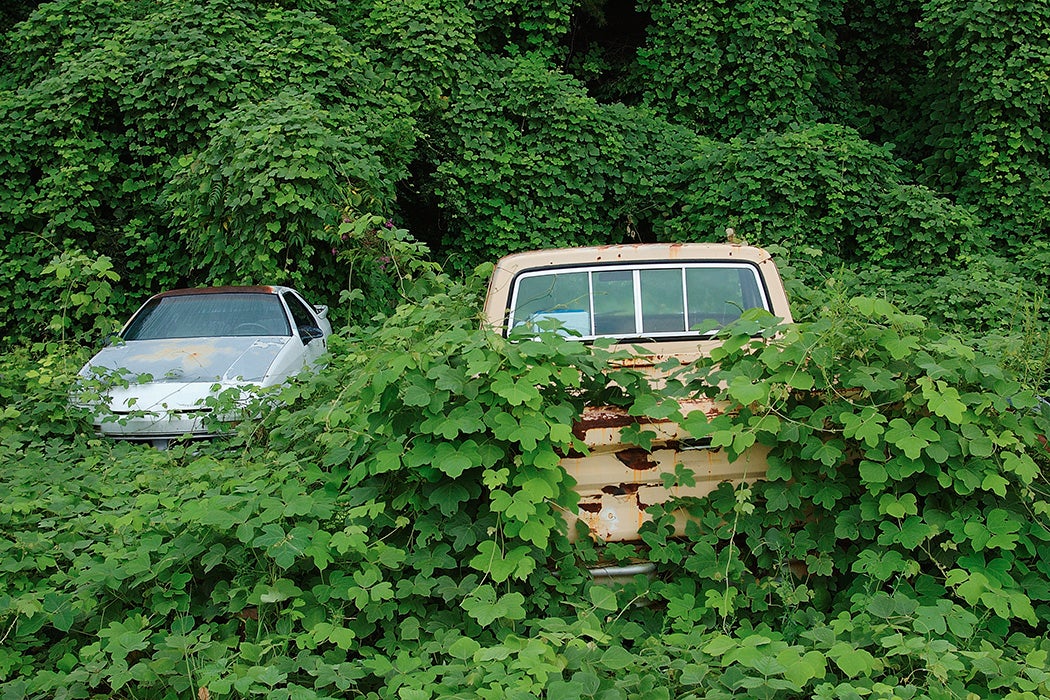
Across the American South, few plants are as recognizable as kudzu. Its vines blanket trees and power lines, turning roadside clearings into walls of green. Over time, this landscape has given rise to the story of a “vine that ate the South,” with kudzu framed as a menacing invader that swallows everything in its path.
But kudzu’s presence in the South is more complicated than this myth suggests. Brought to the region to address economic and environmental woes shaped by the ghost of plantation slavery, kudzu was later abandoned as shifting needs rendered the plant unnecessary. Though its purported usefulness was short-lived, kudzu has persisted in both the landscape and the collective memory of the South.
Kudzu (Pueraria montana) is a perennial climbing vine native to East Asia, particularly China and Japan. It has broad leaves, organized in groups of three, and large, tuberous roots, which allow the plant to survive and regenerate even after its aboveground growth is removed. Under favorable conditions with plenty of rainfall and mild winters, Pueraria montana can grow as much as sixty feet in a season, with some reports alleging that its vines may extend by roughly twelve inches in a single day during periods of rapid growth.
Kudzu also fixes nitrogen through its symbiotic relationship with soil bacteria, allowing it to thrive in nutrient-poor or heavily disturbed soils. It is especially successful in sunny, open environments, such as forest edges, roadsides, and abandoned fields. As a result, kudzu is exceptionally skilled at flourishing in damaged landscapes.
Kudzu’s characteristics made it well suited to thrive in the southeastern United States. The plantation economy that developed in the American South institutionalized an intensely extractive relationship with the land. As historian David Silkenat argues in his book Scars on the Land: An Environmental History of Slavery in the American South, Southern planters prioritized maximizing production through enslaved labor rather than sustaining the health and long-term productivity of the land.
The result was a landscape repeatedly cleared and exhausted for cotton and other cash crops. By the twentieth century, intensive farming practices had left the South dangerously vulnerable to erosion, producing depleted swaths of land where kudzu would later flourish. Kurt Kinbacher traces this history to an enduring American assumption that land was essentially limitless, citing a 1909 Bureau of Soils declaration that “soil is one indestructible, immutable asset that the nation possesses” and “the one resource that cannot be exhausted; that cannot be used up.” In reality, decades of land abuse and exploitation left behind a scarred terrain uniquely prepared for the arrival of kudzu as a fast-growing pioneer plant.
Extract — continue reading at the source.