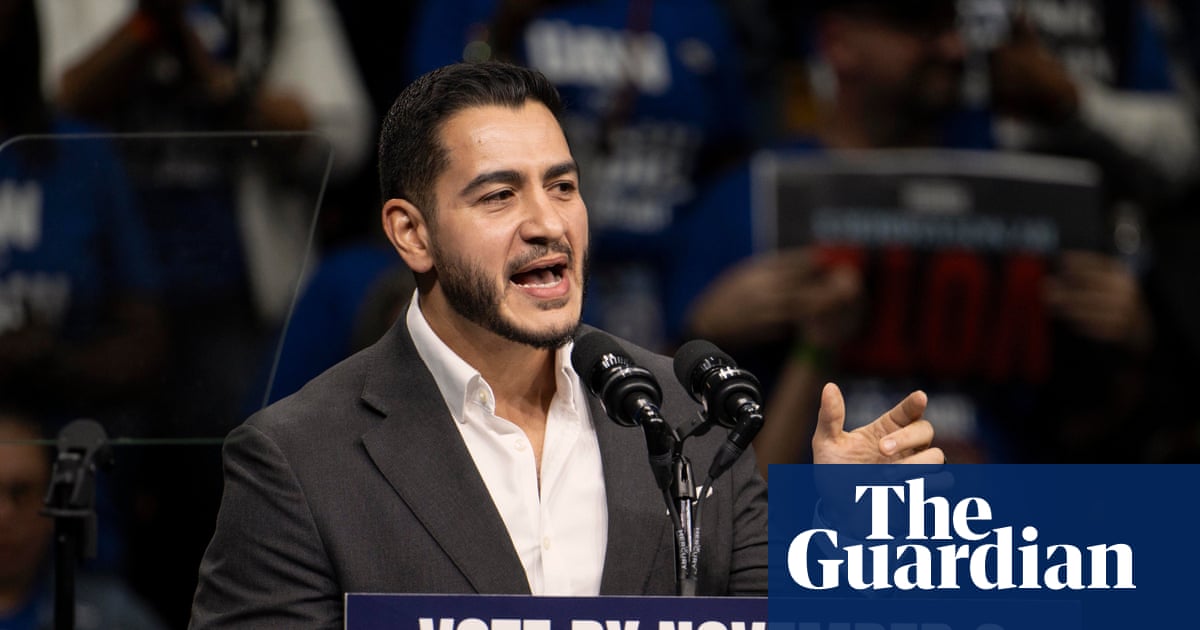
The Republican campaign to defeat Democrat Abdul El-Sayed in the Michigan Senate race by casting him as an Islamic extremist is based on a false claim first made by the conspiracy theorist Laura Loomer eight years ago, a Guardian review of the evidence reveals. Loomer, an influential outside adviser to Donald Trump who calls herself “a proud Islamophobe”, has claimed since El-Sayed entered politics in 2018 that an open letter he signed in support of democracy in Egypt in 2012 was a public endorsement of the Muslim Brotherhood. The text of the letter, however, does not even mention the Muslim Brotherhood, and is not, as Loomer maintains, “a pledge” of support for the Egyptian Islamist group.
Because the letter was only published in Arabic, in the chaotic aftermath of the Arab Spring uprising that toppled a dictator, El-Sayed’s opponent, former congressman Mike Rogers, has been able to mischaracterize it without much scrutiny from US political journalists unfamiliar with Egypt’s brief experiment in democracy, which was snuffed out in a 2013 military coup. Rogers began his campaign against El-Sayed in August by restating the false claim first made by Loomer about the letter: that the Michigan-born son of Egyptian immigrants had “pledged his support to the Muslim Brotherhood”. That false account of the letter, in which prominent Egyptian Americans had urged Egypt’s first elected president, Mohamed Morsi, a former member of the Muslim Brotherhood supported by secular activists, to defend their nascent democracy, has been amplified in bigoted remarks about El-Sayed from Trump, Ted Cruz and Robert F Kennedy Jr in recent days.
The allegation went viral two weeks ago, when a Republican operative posing as an ordinary voter asked El-Sayed if he would “disavow the Muslim Brotherhood”, and the candidate replied, “Sure, yeah, absolutely,” before comparing the fearmongering about his faith to fears about John F Kennedy’s Catholicism in 1960. In Michigan’s final Senate debate last week, Rogers claimed that El-Sayed was so “passionate about defunding the police” that he even “asked the new brother – Muslim Brotherhood, excuse me, head, Morrissey [sic], in Egypt – to defund the police there too”. The Egyptian revolution that toppled dictator Hosni Mubarak in 2011 began with widespread demonstrations on Police Day, a national holiday dedicated the repressive dictatorship’s police force.
The falsehood about the letter is at the center of Rogers’ closing message too. In a television ad released last week, Rogers said that the Democrat “has ties to the Muslim Brotherhood” and “publicly supported these terrorists”, as images of El-Sayed superimposed over footage of Hamas militants in Gaza appear on the screen behind him. The ad closes with Rogers warning: “Abdul El-Sayed’s radical ideology is a threat to our national security.” In fact, as the Egyptian journalist Hossam el-Hamalawy confirmed to the Guardian this week, the actual text of the letter El-Sayed signed, as a medical student at Columbia University, “makes no reference to the Muslim Brotherhood” and simply “called on Morsi to pursue the goals of the revolution by purging the state institutions, particularly the police and state media, of officials loyal to the former regime”.
While the headline published above the letter by the editors of the Egyptian state newspaper Al-Ahram, which was still controlled at the time by loyalists to the deposed Mubarak, did call it a plea from “Morsi’s supporters in America”, Hamalawy notes: “The signatories themselves did not use that description.” Asked to comment on the attempt to mislead American voters about El-Sayed’s support for democracy in Egypt, Hamalawy observed: “I see the American right wing borrowing directly from the playbook of Arab authoritarian regimes before, during and after the Arab Spring. These regimes have consistently sought to portray demands for democratic change as inherently Islamist-driven, suggesting that any challenge to authoritarian rule would inevitably pave the way for reactionary Islamist forces or even terrorism.” “It is particularly ironic given that many of these same regimes have long enjoyed the political and military backing of western governments,” he added. The depiction of the Egyptian Muslim Brotherhood as a terrorist group is also misleading, since it is a political and social group with no armed wing that is not on the US state department’s list of designated Foreign Terrorist Groups.
The group was officially banned but tolerated as the main opposition force to Mubarak’s government before the 2011 uprising. After Morsi was elected president in 2012, Rogers himself, then the chair of the House intelligence committee, told that the US government should be wary of the group Morsi had previously helped lead but could engage with some members of the group. The tentative US engagement with members of the Brotherhood appointed to Morsi’s short-lived government in 2012 gave birth to a sprawling conspiracy theory that Huma Abedin – a Muslim aide to Hillary Clinton, who was the US secretary of state at the time –was a secret agent of the Muslim Brotherhood.
Extract — continue reading at the source.