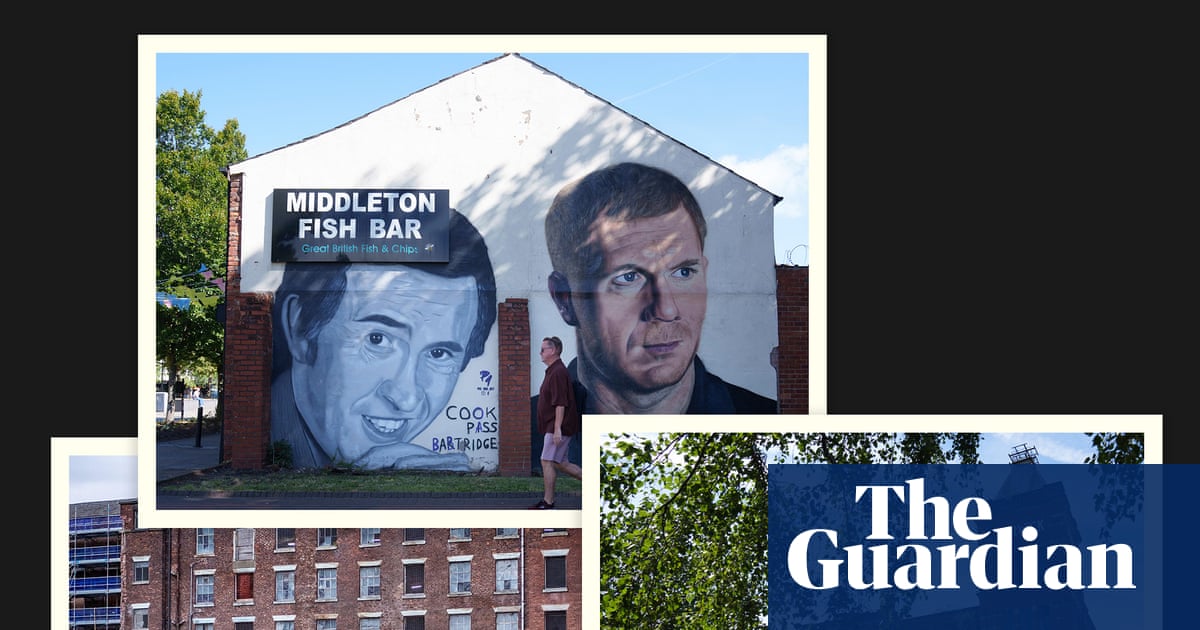
The former England footballer Paul Scholes and the actor Steve Coogan stare out from beside a fish and chip shop in Middleton, near Manchester. Looming over a mural of the pair – and the whole town – is an enormous former cotton mill that powered its economy a century ago. The deafening looms and spindles of Warwick Mill fell silent decades ago, replaced in recent years by TikTok “urban explorers” who share videos of themselves crawling through its abandoned shell.
Yet the old building may have life inside it yet: last month Rochdale council wrestled Warwick Mill out of the hands of its absentee owner, a millionaire Chinese businessman, under whom it had been derelict for years. Now the Grade II-listed site is at the centre of plans Andy Burnham believes could turn Middleton, where he was once a trainee journalist, into a blueprint for the future of Britain’s struggling towns. It’s lost character and we’ve hardly got any shops.
We haven’t even got a bank now – I never thought NatWest would leave Middleton. It’s just going downhill.” A few miles between Manchester and Rochdale, Middleton is typical of the existential crisis suffered by most British towns. A decade or so ago, locals could find virtually everything they needed in its neat square of grocers, butchers and banks.
But a giant Tesco has hoovered up the cash since it opened in 2013, compounding the rise of online and out-of-town shopping. The town of about 50,000 people has lost all its banks and, days before Burnham became prime minister, the remains of its post office were closed by Modella Capital, the new private equity owner of WH Smith. Now the shopping precinct offers little more than bookmakers, vape stores, pawnbrokers and fast-food outlets.
Even its geographic identity feels muddled. Middleton was historically in Lancashire but the town has a Manchester postcode and dial code, although residents pay their council tax to Rochdale. The region’s lauded tram network does not stop here.
We’ve lost out on the trams. We haven’t got anything down here, to be honest.” But six miles from the birthplace of the modern co-operative movement in 1844, a community fightback is under way. Months before he departed for Downing Street, Burnham launched a mayoral development corporation for Middleton, giving local leaders power to set lower business rates, acquire underused land and property, and build 1,500 new homes.
Extract — continue reading at the source.