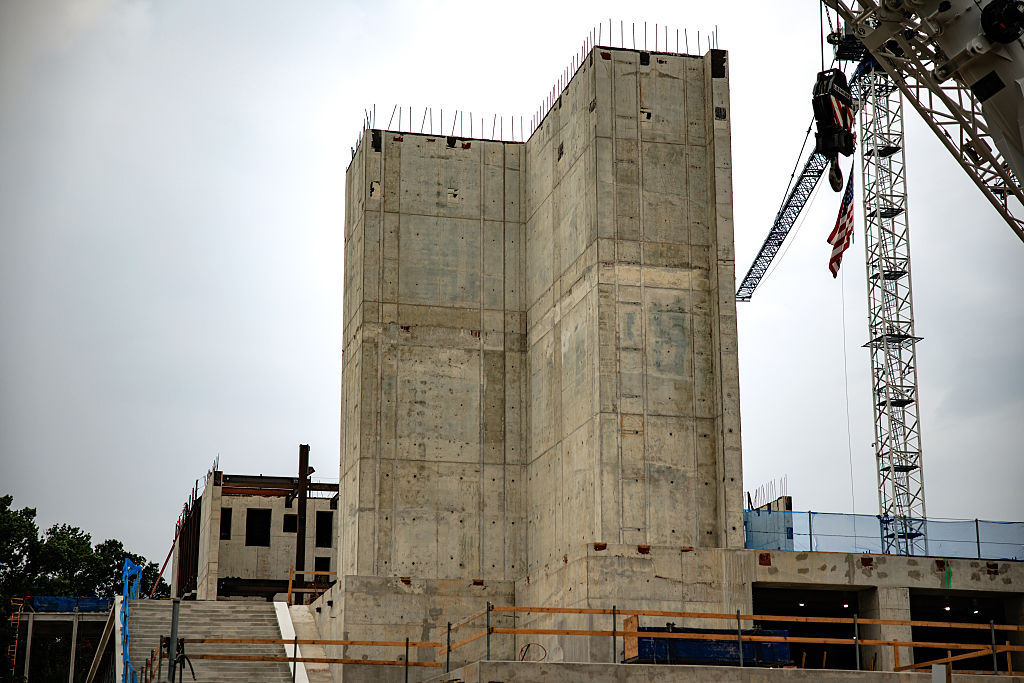
President Donald Trump announced Sunday that his proposed “triumphal arch”—which is planned for Memorial Circle near the Virginia end of Arlington Memorial Bridge in Washington, D.C.—will serve as a military complex with drones, ammunition storage, and sniper facilities. In his initial proposal, Trump said that the arch was meant to commemorate America’s 250th anniversary. Read More: How Trump’s Proposed Triumphal Arch Stacks Up Against Others Around the World Trump has also argued the arch is significant because it brings the United States on par with other world capitals featuring similar monuments.
He emphasized that point again on Sunday, writing: “Out of the 59 top cities and Capitals, Washington, D.C., IS THE ONLY ONE IN THE WORLD THAT DOES NOT HAVE A TRIUMPHAL ARCH, but it will now and, by far, the greatest of them all.” Trump did not identify the 59 cities he was referring to or explain the basis for the comparison. He appeared to mean that Washington was the only one among a group of leading world cities and capitals that lacked a triumphal arch. His post said that the changes to the plan for the arch came “at the strong request of the United States Military” and had been made “for National Security purposes.” The President’s post did not elaborate on the security role that a militarized arch would play in Washington, and Trump has not made public any revised proposal, model, or mockup of what changes that might entail.
TIME has reached out to the White House and the Pentagon for comment. Trump’s new description of the arch echoes the Administration’s defense of another signature construction project: the White House ballroom. The White House ballroom was initially presented as a privately funded venue for state dinners and other large events.
In subsequent litigation, however, the Administration argued that the ballroom and the underground military facility beneath it constituted a single, integrated project. That argument emerged amid legal challenges to construction already underway at the site of the former East Wing. On March 31, a judge ordered the ballroom project halted unless authorized by Congress, while leaving open an exception for work necessary to ensure the safety and security of the White House.
The Administration subsequently argued that the security exception allowed the entire project to continue—claiming that it is one “massive” military complex that is “vital” to national security. Prior to litigation, Trump had called the $400 million ballroom a social and diplomatic space to “host major functions honoring world leaders.” But in court documents filed last month, Solicitor General John Sauer raised the stakes, writing: “Every day the President does not have access to the vital security features of the military complex presents unacceptable risk.” On Aug. 31, the Supreme Court stayed the injunction, allowing construction to continue while the government seeks further review. The Court did not rule on the project’s legality.
Much like the ballroom project, the triumphal arch has been the subject of legal and political scrutiny since it was announced in 2025. Commission of Fine Arts—whose members were all appointed by Trump—approved the project’s design in May. House Democrats called it a “vanity” project and introduced a bill to Congress to block its construction, along with the construction of any triumphal arch exceeding 50 feet on any National Park Service (NPS) lands in Washington “except by express authorization of Congress.” Democrats also argued that the arch was an unnecessary expenditure amid the affordability crisis affecting Americans.
Extract — continue reading at the source.