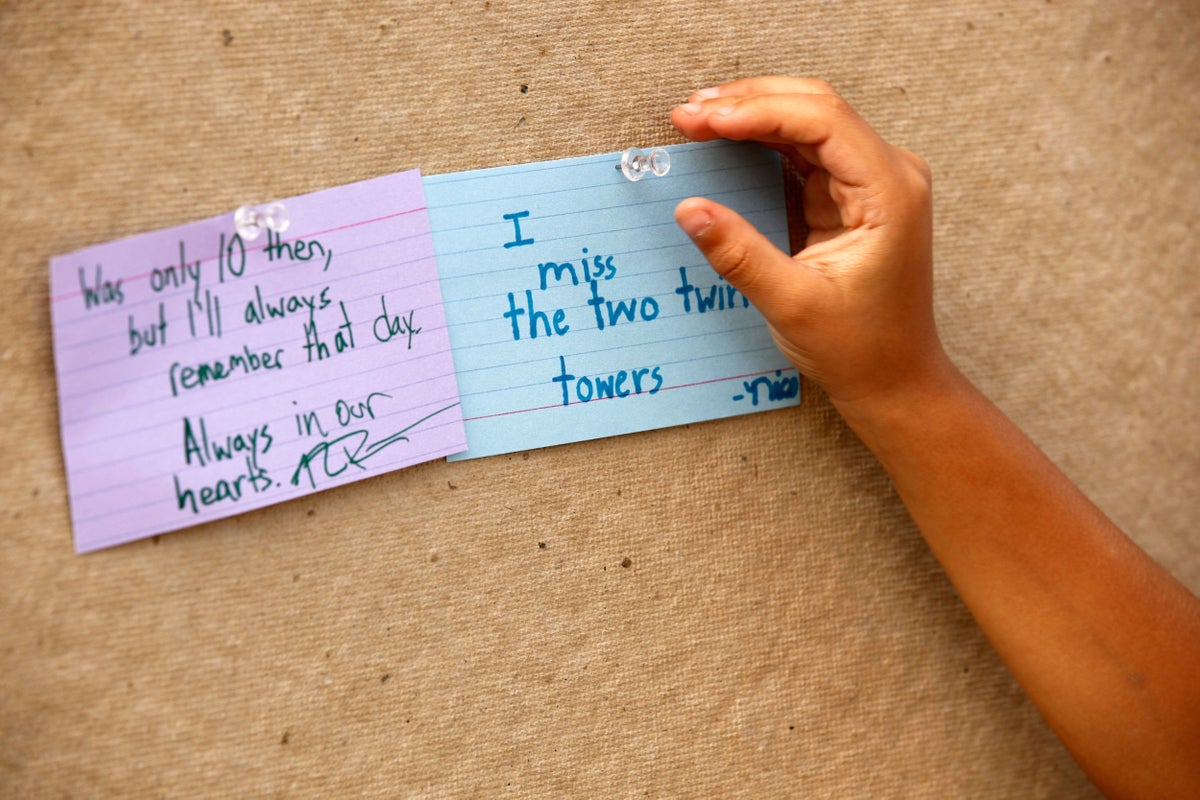
On back-to-school night in 2005, I eagerly entered my youngest child’s first grade classroom. The walls were festooned with brightly colored responses to the prompt: “Draw something you remember.” I scanned for my son’s picture and was shocked when I encountered his drawing: an airplane flying into New York’s World Trade Center. But I do remember you crying.” My son was not quite 2 years old on Sept. 11, 2001.
As a mother, I despaired to learn that my own reaction to that day’s tragedies had stuck with him so viscerally. As a professor and researcher of children’s media, I shouldn’t have been surprised. My son’s memory was likely influenced not just by my emotional reaction but by the media around him that his parents and siblings consumed in the weeks and years after the attacks – a mix of TV news and content geared toward kids.
More than two decades later, children have many more ways and more platforms to encounter frightening images and stories, often without an adult nearby to help them make sense of what they see. But the ways children’s programming such as “Sesame Street” responded to 9/11 offer a useful lesson: Rather than trying to shield children completely from disturbing events, adults can help them process what they’ve seen in honest, reassuring and age-appropriate ways. Psychologist Joanne Cantor was one of the first to study what scares children about news and how they respond to it.
She concluded that what frightens children varies by their developmental stage. Younger children tend to notice and respond to stories about natural disasters and tragedies about kids or animals. Older children are afraid of stories focusing on personal injury and physical destruction, kidnapping, disease and violence.
Teens express fear of stories about random acts of violence, natural disasters and foreign conflicts. New subscribers only. £9.99/mo. after free trial. Plan auto-renews until cancelled.
This revenue helps to fund journalism across The Independent. Since Cantor first published her groundbreaking research in the 1980s, kids’ media environments have changed dramatically, with more channels, screens and platforms broadcasting images and videos of natural disasters, violence and tragedies from around the world. One study found that young children’s exposure to news is often accidental but lasting, with many children recalling distressing images long after the fact.
Extract — continue reading at the source.