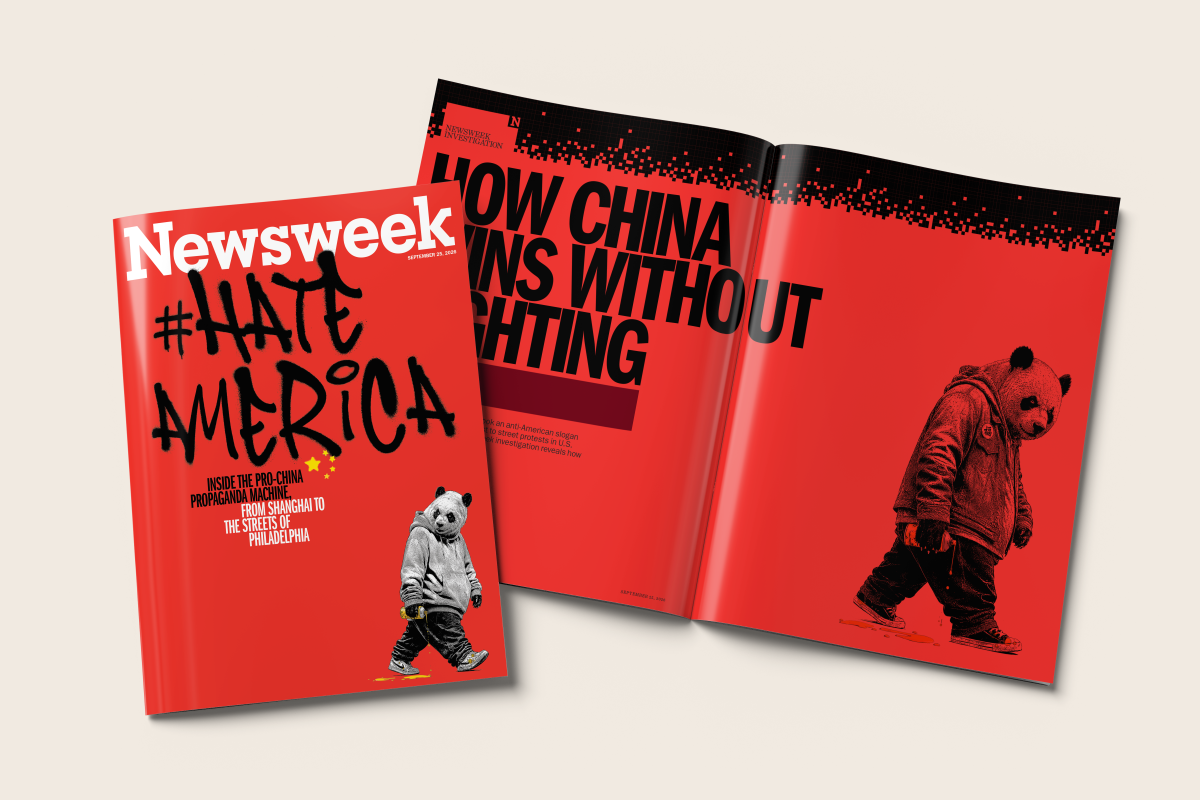
By the end of April, the slogan had a launch event chaired in Beijing. A conference in Colombo, the capital of Sri Lanka, turned it into a signed declaration in July. From there it spread to the U.S. where, in August, activists held public rallies and closed-door political meetings in Philadelphia and New York, following a late-July event on “insurgency” requiring participants to wear masks—perhaps not to limit the spread of disease, but so they could not be identified.
Slogans can travel fast, but a Newsweek investigation has found that this one did not travel around the world—and end up in America—on its own. Our investigation reveals: Political warfare has been researched and taught inside the ruling Chinese Communist Party and the People’s Liberation Army for decades and is regarded there as the highest form of warfare: how to win without fighting. Our investigation shows that doctrine operating in practice—on American allies, on the world’s biggest short-form video platform, on American streets.
The U.S. was once good at this too, but it let its political warfare capability wither at the end of the Cold War. Analysts and officials who study the problem say America is now unequipped to answer this massive new threat, that it has become merely reactive and not proactive, and—according to a review by the U.S. House Permanent Select Committee on Intelligence—its counterintelligence capabilities are “too little too late.” The official launch of the campaign against U.S. military bases in allied Asian nations, such as South Korea, Japan and the Philippines, was marked on April 30 with a webinar titled: “HANDS OFF ASIA!
Peace, Sovereignty and Anti-U.S. Militarism.” Chaired in Beijing by Tings Chak, Tricontinental’s Asia co-coordinator, the timing was a deliberate poke in America’s eye—the 51st anniversary of the fall of Saigon that marked the U.S. defeat in the Vietnam War. They also import conflict.” Things went IRL in mid-July in Colombo, where a conference attended by scores of activists from the U.S. and Asia produced a Colombo Declaration for People’s Sovereignty and Solidarity that said: “The enemy is one and indivisible.
Hands off Asia!” The campaign excoriates “the enemy” militarily, economically and politically, and for what it calls “brain capture,” or ideological control. By August, the action had reached Philadelphia and New York, where a clutch of established or new “anti-imperial” groups, including the Anti-Imperialist South Asian Alliance and pro-North Korean activist group Nodutdol (“stepping stone” in Korean), which campaigns against U.S. bases in South Korea, held closed-door meetings and public rallies transmitting aligned messages. The overarching aim is “America skepticism,” according to experts of Chinese political warfare.
Dig, and a pattern emerges: a carousel of groups and grievances; an echoing ecosystem of online and offline hybrid events, hashtags and narratives; a massive, overlapping, globalized Venn diagram of organizations and people all effectively bearing the same message: Hate America. There are hundreds, perhaps thousands, of organizations involved. Many connect back to Shanghai-based Singham, who has heavily funded key groups including Tricontinental and the main Colombo Declaration organizer, the International Peoples’ Assembly.
Extract — continue reading at the source.