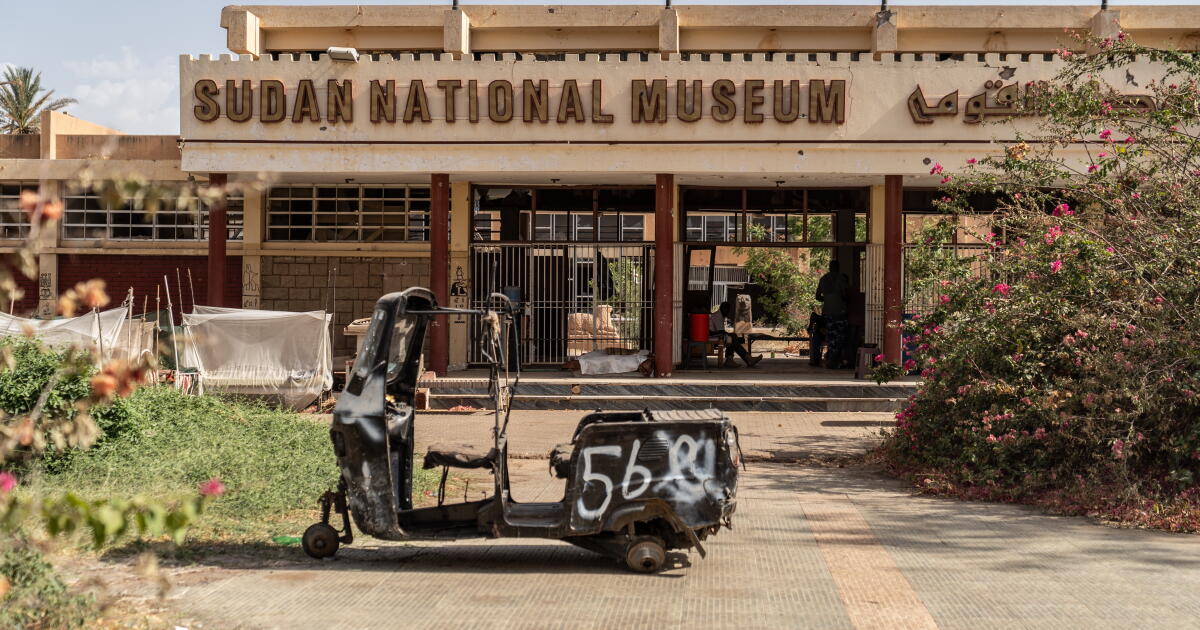
KHARTOUM, Sudan — The ancient statues of the deities Heket and Beset, too heavy to move, were used for target practice. The 4,000-year-old skeletal remains from the bio-archaeology lab? The gold vault lays ransacked, the storage rooms firebombed.
Walk through the grounds of the Sudan National Museum and the reminders of the civil war’s devastating impact on this country’s cultural history seem everywhere. They entered the depots and stole everything they could,” said Umaima Abdul-Rahman Al-Sanusi, one of the museum’s curators, as her eyes scanned a shattered display case. She was referring to the Rapid Support Forces, or RSF, a paramilitary group that controlled the capital — and the museum with it — from April 2023 until government forces dislodged them in March of last year.
When Al-Sanusi first saw the level of destruction in the museum — where she’s been employed around 15 years — she cried. Even now, more than a year after she and her colleagues returned to the museum, her voice was tight with not-quite-resigned frustration. Like gold, oil, gum arabic and other resources, Sudan’s archaeological treasures, a legacy of the successive kingdoms that flourished and died in the Nile Valley over millennia, have been commandeered to power a war machine that has killed hundreds of thousands and displaced some 14 million people.
At least 76 heritage sites and 20 museums have been ransacked by the RSF and run-of-the-mill thieves, officials say, carting off an archaeological haul worth more than $150 million. One museum was turned into a barracks. The National Museum alone lost almost two-thirds of its inventory, comprising nearly 100,000 artifacts that covered Sudan’s prehistoric age through its Nubian era, the Kingdom of Kush, the Christian era and its Islamic period. 1.
Sudanese visitors walk past examples of 10th century Christian art work at the national museum in the capital Khartoum on June 25, 2008. (Khaled Desouki / via Images) 2. Haitem el-Nour, new director of the national corporation of antiquities and museums looks at a collection of antiquities at the Sudan National Museum in the capital Khartoum on August 12, 2020. - (Ashraf Shazly / via Images) 3. Buhen temple in the national museum, Khartoum State, Khartoum, Sudan on January 5, 2019 in Khartoum, Sudan. (Eric Lafforgue/Art in All of Us/Corbis via Images) Some items were smashed and shattered when the museum’s grounds became a run-and-gun battlefield.
The museum was undergoing renovations before the war, so most of the collections were packed in the main warehouse. The RSF stole the artifacts in the same boxes where they were stored, said Jamal Zaid Al-Abideen, a veteran official at the National Corp. for Antiquities and Museums. Behind it was the vault that once contained almost 2,000 objects of 24-carat gold, gem-ornamented Nabatean funerary figures and ancient jewelry from the Kingdom of Kush.
Extract — continue reading at the source.


