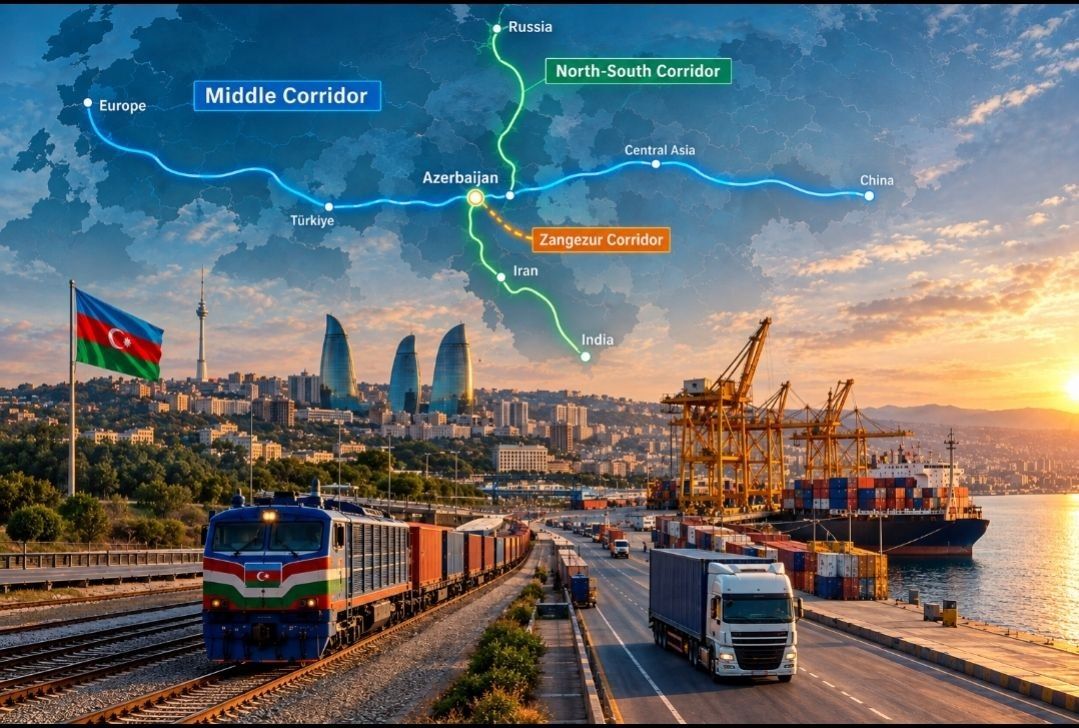
A few years ago, talk about Eurasian transport corridors mostly came down to finding the shortest route between Asia and Europe. Today, with global trade being reshaped, with higher demands on supply-chain security, and with countries wanting to diversify their routes, it's the whole system of transport links that matters. Azerbaijan holds a special place in this new geography.
Over the past few years, by carrying out large-scale infrastructure projects along the East-West and North-South corridors, the country has turned into a reliable logistics hub for the region. Its geographic position and the strategic projects it implements have made Azerbaijan an important transport partner across the Greater Eurasian space, and freight volumes keep growing year after year. At first glance, North–South and the Middle Corridor look like completely different projects.
The International North-South Transport Corridor is aimed above all at moving goods between India, the Gulf states, Iran, Azerbaijan, Russia and, further on, Northern Europe. The Middle Corridor works on a different geography. It connects China and Central Asia with the South Caucasus, Türkiye and European markets.
Its backbone is made up of rail and road routes, the sea crossing over the Caspian, and onward movement through Azerbaijan, Georgia and Türkiye toward Europe. In recent years, Azerbaijan has steadily pursued a policy aimed at turning itself from a transit country into a logistics and transport hub with far broader functions. Billions of dollars invested in railways, highways, port infrastructure, logistics centres and digital solutions are already starting to produce real results.
According to the State Statistics Committee, from January to May of this year, 6,159.7 thousand tons of cargo were carried by rail along Azerbaijan's international transport corridors, 4,731 thousand tons by road, and 2,652.5 thousand tons by sea. Rail therefore accounted for 45.5% of total freight, road for 34.9%, and sea for 19.6%. Compared with the same period last year, rail traffic rose by 3.3% and road traffic by 5.9% - which is seen as a sign of growing demand for Azerbaijan's transit capacity.
Earlier, President Ilham Aliyev, in his address to participants of the 2nd Azerbaijan International Investment Forum, highlighted Azerbaijan’s growing role in the evolving transport and economic architecture of Eurasia. "Located at the intersection of the East-West and North-South corridors, Azerbaijan has become an important link and gateway between Asia and Europe. The Middle Corridor links Central Asia across the Caspian Sea with the South Caucasus, Türkiye and Europe, while the emerging Zangezur Corridor, also known as the TRIPP connectivity route, will further strengthen Azerbaijan's role as a regional hub, and create new opportunities for trade, investment and industrial cooperation across Eurasia," the Azerbaijani leader said.
Extract — continue reading at the source.