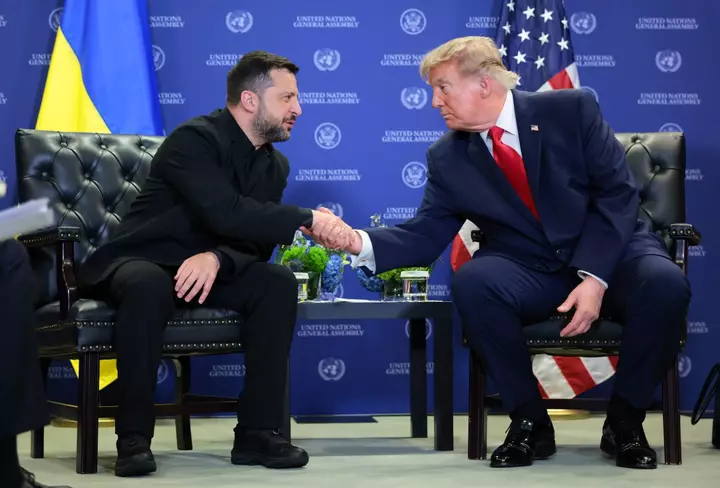
As Americans go to the polls for the midterm elections, Ukraine will be keenly watching if voting mirrors polling and causes a congressional shift toward the Democrats, who have championed the fight against Vladimir Putin's aggression. During his second term, Donald Trump's relationship with his Ukrainian counterpart Volodymyr Zelensky ebbed and flowed—ranging from a public White House spat to the U.S. president signing from the Resolute Desk a tough sanctions bill against Russia. Experts told Newsweek that sanctions, military support and missile defense are at stake for Kyiv should the Democrats take the House and the Senate but Trump would still hold the very cards he said Zelensky lacked during their infamous White House confrontation.
"Ultimately, Trump and his foreign policy team have the prerogative to set U.S. policy toward Ukraine," Matthew Arnold, a political expert from the London School of Economics think tank LSE Ideas, told Newsweek. Zelensky welcomed the U.S. approval of the possible sale of 500 PATRIOT Advanced Capability-e (PAC-3) Missile Segment Enhancement (MSE) missiles and related equipment to Ukraine, announced by the State Department on 30 October, but is worried it could be years before Kyiv gets the kit. And as Ukraine braces itself for the toughest winter of the war, Russia is stepping up its attacks on energy infrastructure to freeze Ukrainians in the cold months in a tactic by Putin to offset a front line stalemate.
In these difficult circumstances, Democratic gains will not have an immediate effect on Ukraine's ability to defend itself from Russia's drones and missiles. "A change in congressional leadership would put fresh Ukraine aid back on the agenda—but it won't resolve the short-term shortage of Patriot air-defense supplies," said Yuriy Boyechko, CEO of Hope for Ukraine, which helps communities on the war's front line. New appropriations would secure the financial framework for future arms transfers, but the physical delivery of interceptors is constrained by defense production limitations and delivery lead times of years, he said.
"A political shift is a positive indicator for long-term funding sustainability, yet insufficient on its own to immediately increase Patriot availability on the battlefield," Boyechko told Newsweek. In any case, the global stock of PAC-3 interceptors is constrained, demand has increased dramatically because of the war in Iran, and production takes years to expand. "A new Congress could put pressure on the Pentagon to prioritize Ukraine, accelerate production and approve transfers from allied stocks, but it cannot solve the shortage overnight," Aurélien Colson, academic co-director of the ESSEC Business School Institute for Geopolitics & Business, told Newsweek.
"Congress cannot manufacture weapons." Trump wants Europe to pay for Ukraine’s weapons and says that Ukrainian concessions to Russia are essential for any peace deal, said Arnold, who is director of LSE IDEAS’ Democratic Resilience in a New Age of War Program. "I don’t think he’ll change that even after the elections," he added, "I don’t see the Trump administration reasserting the approach of the Biden administration or even softening his own approach, whatever happens in U.S. politics." Trump's sidestepping of Congress on Ukraine issues during his second term have shown legislation is not necessarily carried out as lawmakers had wanted it. Soon after signing a much-lauded sanctions bill pushed by late Senator Lindsey Graham to throttle Moscow's war machine, Trump lifted restrictions on Russian diesel imports into the U.S. to ease pressure on gas prices.
Russia’s renewed participation in the G20 which Washington pushed for and U.S. imports of Russian diesel "were widely loathed steps across both parties, but Trump still did it," said Arnold. Also, despite Congress authorizing military aid worth $400 million, the Pentagon delayed the release of the assistance until the end of April after months of bureaucratic hurdles. "History shows that administrations of both parties readily utilize statutory waivers or soft-pedal secondary sanctions when enforcement conflicts with broader economic or foreign policy goals," said Boyechko.
Extract — continue reading at the source.