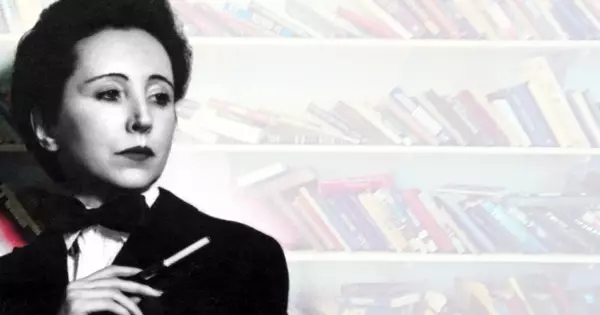
Nin herself — a woman uncommonly liberated from the common traps of convention, control, and self-consciousness — took up the spiritual mechanics of this paradox in her first published book, D. Lawrence: An Unprofessional Study (public library), composed when she was still in her twenties. Lawrence (September 11, 1885–March 2, 1930) and his “philosophy that was against division,” his “plea for whole vision,” she writes: When the realization came to the moderns of the importance of vitality and warmth, they willed the warmth with their minds.
But Lawrence, with the terrible flair of the genius, sensed that a mere mental conjuring of the elemental was a perversion… Lawrence believed that the feelings of the body, from its most extreme impulses to its smallest gesture, are the warm root for true vision, and from that warm root can we truly grow. The livingness of the body was natural; the interference of the mind had created divisions, the consciousness of wrong-doing or well-doing. In a sentiment central to my own animating ethos, she adds: Life is a process of becoming, a combination of states we have to go through.
Where people fail is that they wish to elect a state and remain in it. It was Lawrence’s own writing that awakened in her this awareness of ongoingness and the urgency of total aliveness — the way “livingness is the axis of his world, the light, the gravitation, and electromagnetism of his world.” In his 1924 novel The Boy in the Bush, Lawrence makes a stunning case for the indivisibility of it all — the beauty and the sorrow, the ache and the astonishment: All real living hurts as well as fulfils. Happiness comes when we have lived and have a respite for sheer forgetting.
Happiness, in the vulgar sense, is just a holiday experience. The life-long happiness lies in being used by life; hurt by life, driven and goaded by life, replenished and overjoyed with life, fighting for life’s sake. In the undergoing, a large part of it is pain.
This was the foundational philosophy of Lawrence’s worldview — the pulse-beat that makes his writing so resonant and eternally alive, the way all great spiritual texts are. He distilled this view in an especially beautiful passage from his 1923 novel Kangaroo, reckoning with the most universal reality of life — the reality we spend our lives fighting, yet the one that peeks through in all of our greatest works of art and highest triumphs of the creative spirit. Echoing Whitman’s defense of our inner multitudes, often at odds with each other, he writes in an era when every woman was a “man” purely as a matter of linguistic convention: If a man loves life, and feels the sacredness and mystery of life, then he knows that life is full of strange and subtle and even conflicting imperatives.
And a wise man learns to recognize the imperatives as they arise — or nearly so — and to obey. But most men bruise themselves to death trying to fight and overcome their own, new, life-born needs, life’s ever strange imperatives. The secret of all life is obedience: obedience to the urge that arises in the soul, the urge that is life itself, urging us to new gestures, new embraces, new emotions, new combinations, new creations.
Extract — continue reading at the source.