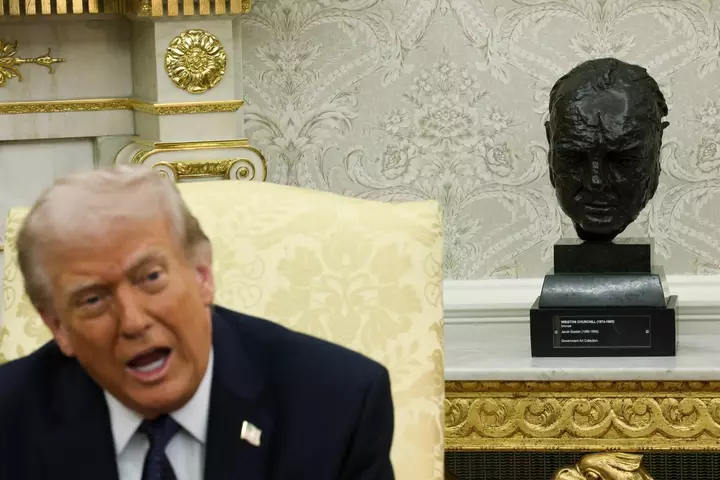
When Donald Trump wanted to cut Keir Starmer down to size in March, he reached for his hero. "This is not Winston Churchill," the president said in the Oval Office, after Britain initially refused to let U.S. forces use its bases, including Diego Garcia, for strikes on Iran. Trump has often made clear his reverence for Churchill.
On his first day back in the White House in 2025, Trump restored a bust of Churchill to the Oval Office, just as he had in 2017, righting, as he saw it, a wrong made by two Democratic presidents. During the pandemic, Trump likened himself to the wartime leader who, he said, would "go to a roof in London and speak" as Adolf Hitler’s bombs fell. Today, like Churchill, Trump is facing an escalating European crisis and a difficult Kremlin.
But is Trump as Churchillian as he presents? How does Trump’s handling of Vladimir Putin and the Ukraine war compare with how Churchill dealt with the huge issues he faced during World War II and the Cold War? Put simply: what would Sir Winston do?
Historians of Churchill’s dealings with Moscow have answers that may unsettle Trump’s admirers and critics alike. Churchill would very likely have sought a summit with Putin, and he might well have leaned on Kyiv to accept a hard bargain. But he likely would have insisted on negotiating from strength, with Europe in the room, for stakes he judged strategic.
Trump is channeling a real Churchill, just not the one he imagines. Not the defiant leader of 1940, but the deal-hungry summiteer of 1944. The difference is that Churchill, playing a weakening hand, still extracted a price.
On October 21, Trump’s envoy Steve Witkoff met Putin in St. Petersburg for the ninth time, and praised the man raining missiles on children’s playgrounds in Ukraine as a "humanitarian." It followed Trump’s October 9 deal for Russian diesel, and his October 16 waiver of most of the sanctions and tariffs imposed on Russia in a bipartisan law he had signed less than a month earlier. There is a case for bringing Russia closer in the interests of resolving the Ukraine crisis.
Extract — continue reading at the source.