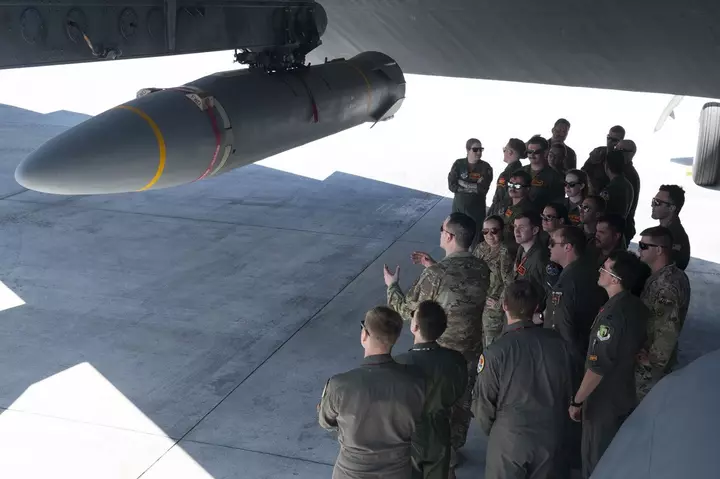
The U.S. military has awarded defense giant Lockheed Martin a contract worth nearly $700 million to pump out a previously-shelved hypersonic weapon that can be launched from U.S. The contract is part of the so-called Arsenal of Freedom unveiled by Defense Secretary Pete Hegseth, referring to a Pentagon push toward churning out more U.S. weapons. The decision to put the Air-Launched Rapid Response Weapon (ARRW) into production is a "turning point" for advanced American weapons, said Air Force Secretary Troy Meink.
Western countries have trailed behind Russia and China in developing hypersonic weapons, which are expensive and difficult-to-produce systems able to travel upwards of five times the speed of sound, or Mach 5. One of the features of a hypersonic weapon, though, is the ability to twist and turn so it is very difficult to intercept before it slams into its target. The U.S. doesn't currently have any operational hypersonic weapons, but it has several programs developing both hypersonic cruise missiles and hypersonic boost-glide systems.
A hypersonic glide vehicle is a warhead or missile launched into space by a rocket and then gliding through the upper atmosphere at hypersonic speeds. In the early 2000s, the U.S. was ahead of the rest of the field in the race to sketch out hypersonic designs, but ultimately de-prioritized these efforts, said William Freer, a research fellow in national security at the U.K.-based Council on Geostrategy think tank. As U.S. interest waned, Washington's competitors stormed ahead, seeing hypersonics as a way to neutralize advances in American defenses, he told Newsweek.
The Pentagon says hypersonic weapons have "fundamentally altered the landscape of military technology and strategy," and pointed to the costs of developing this new class of weapons when unveiling its request for a record defense budget for the 2027 fiscal year. The Trump administration has argued the U. S.—already the world's largest military spender—needs to increase its annual military spending to $1.5 trillion to rebuild weapons stocks and keep up with the U.S.'s adversaries.
Around $38 billion of this would be dedicated to hypersonic programs, according to congressional research. Army and Navy are jointly developing a missile referred to both as the Conventional Prompt Strike (CPS) and the Long-Range Hypersonic Weapon (LRHW). The Army, which officially labeled the latter as Dark Eagle last year, had planned to be able to deploy the missile by 2023.
The Navy, meanwhile, plans to launch the CPS from its Zumwalt-class destroyers—a type of guided-missile warship—as well as from Virginia-class submarines. The missile, beset with delays, may be also fired from the future Trump-class battleships, according to the Government Accountability Office (GAO), the Congressional watchdog. The Navy axed its second planned hypersonic weapon, the Hypersonic Air-Launched Offensive Anti-Surface Warfare (HALO) missile, in 2024 because of cost.
Extract — continue reading at the source.