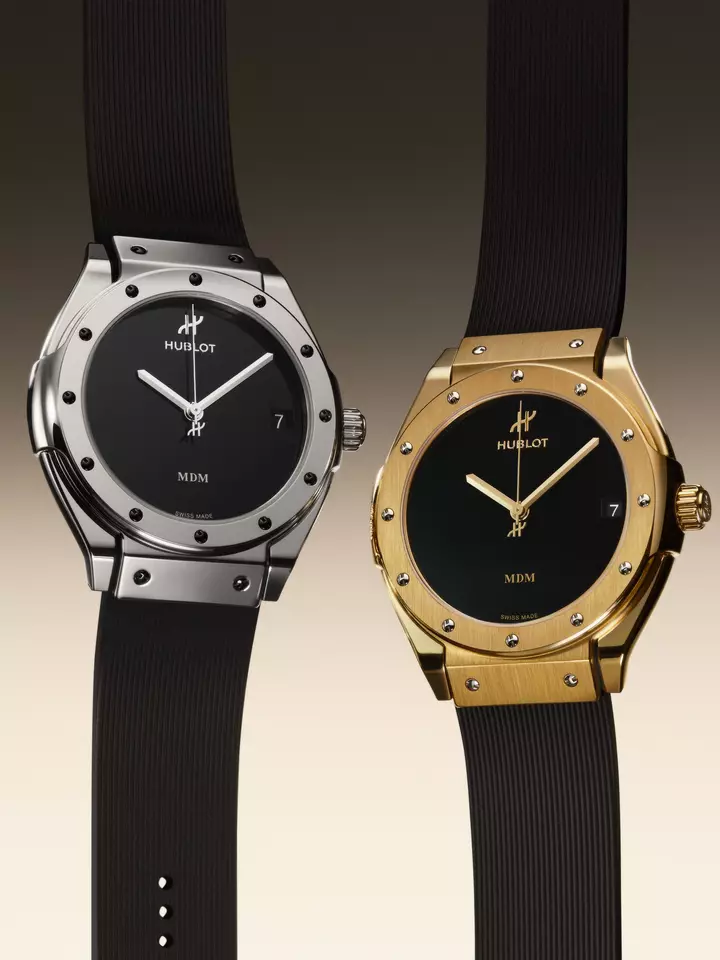
If you spend a lot of time following the world of watches, Hublot’s origin story might feel as familiar as one of the fairytales you heard at bedtime as a child. If you don’t, though, it might feel just as fantastical as some yarn about a princess who feels a pea under a stack of mattresses or a prince who slays a fire-breathing dragon. You start with an unlikely hero.
This time around, it’s an Italian entrepreneur with a big, bold, brazen idea. He wants to make a watch, something unlike anyone has ever seen. It’ll be gold, with an angular case shaped like the porthole on a ship.
Because, breaking entirely with the conventions of the day, the strap won’t be made of exotic leather or precious metal but rubber. Humble, industrial rubber. This is exactly what Hublot founder Carlo Crocco envisioned nearly half a century ago, and what he brought to the Basel Watch Fair—pretty much the place to be if you wanted to be a part of the business of timekeeping—in 1980.
He spent three years developing the idea, all without doing a bit of market research. He just believed in his vision. But the anxiety didn’t have long to fester.
Industry buzz gave way to the kind of clientele most brands can only imagine. The King of Greece bought one in Gstaad for himself and another for his brother-in-law, the King of Spain. More royals followed. (“By the way, they’re all related,” Crocco quips.) But the biggest thing wasn’t getting insiders to a booth at a trade fair or convincing kings to strap Hublot watches—named, if you’re curious, for the French word for porthole—on their wrists.
It was changing how the industry thought about the way watches are made. I personally thought it was a really good idea because it was against the current. It was very risky, but if you don’t risk, you have no result.” The result was a watch industry that completely recalibrated itself.
Extract — continue reading at the source.