As the seat of our cognition, the human neocortex is an object of immense fascination. Human neocortex expansion during evolution has been attributed to an increase in the proliferative capacity of neural progenitor cells during development, particularly basal radial glia. Despite their evolutionary relevance, the genomic changes driving human basal radial glia biology remain uncharacterised.
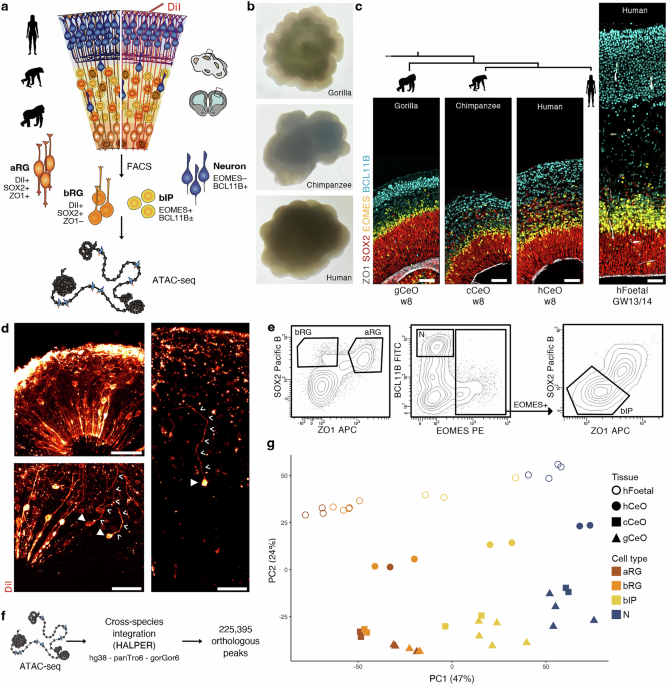
We use comparative chromatin and transcriptional profiling of neural progenitor cells isolated from gorilla, chimpanzee and human cerebral organoids to identify cis-regulatory elements that have gained activity in humans. Focusing specifically on basal radial glia, we discover that morphoregulatory enhancer activity and gene expression signatures distinguish human basal radial glia from other great apes. Functional analysis of the morphoregulatory genes FAM107A and CNGA3 in human organoids reveals that these genes contribute to the morphological complexity of human basal radial glia.
Taken together, our inter-species comparison of basal radial glia suggests that human-specific morphoregulatory signatures characterise neocortex evolution. As the seat of higher-level cognitive functions, including speech, self-reflection, and long-term planning1,2, the neocortex is central to the experience of being human. In the course of primate evolution, the neocortex has undergone a number of significant changes3,4, including a drastic increase in size and neuron number, both of which peak in humans5.
Neocortical neurons arise embryonically from three main classes of neural progenitor cells: (i) apical radial glia (aRG) that divide in the ventricular zone of the developing cortex, (ii) basal intermediate progenitors (bIPs) without ventricular contact that divide in the subventricular zone, and (iii) basal (or outer) radial glia (bRG/oRG) that also divide in the subventricular zone and have repeatedly been implicated in the evolution of neocortex size. The abundance6,7,8,9 and proliferative potential10,11,12 of bRG are tightly linked to increased neuron numbers in the adult neocortex and overall neocortex size. Key factors underlying bRG function include their morphological complexity12,13, lineage relationships12,14,15 and altered cell metabolism16, all of which correlate with larger neocortex size across species.
The human-specific genomic changes underlying human bRG biology remain to be elucidated, promising unique insights into the mechanisms that ultimately provide the basis for higher cognitive functions. While a limited number of human-specific genes affecting bRG proliferative potential and neocortex size have been described3,4,17, a large part of great ape species-specific biology likely originates in the differential regulation of shared genes orchestrated by cis-regulatory elements (CREs)18,19,20,21. Inter-species differences in CRE activity may alter the expression of associated target genes, affecting radial glia biology, as shown for the Wnt receptor FZD822, the growth factor EPIREGULIN23 and HAR198424.
Epigenomic comparisons of foetal brain tissue from different species have identified candidate CREs, termed human-gained enhancers (HGEs), with a potential role in neocortex evolution25,26. Yet, since great ape foetal tissue is not accessible for research, truly human-specific changes in bRG CRE activity have not been elucidated. Recent advances in induced pluripotent stem cells (iPSCs) from great apes have allowed epigenomic comparisons of cultured neural progenitor cells and neurons27,28.
Extract — continue reading at the source.


