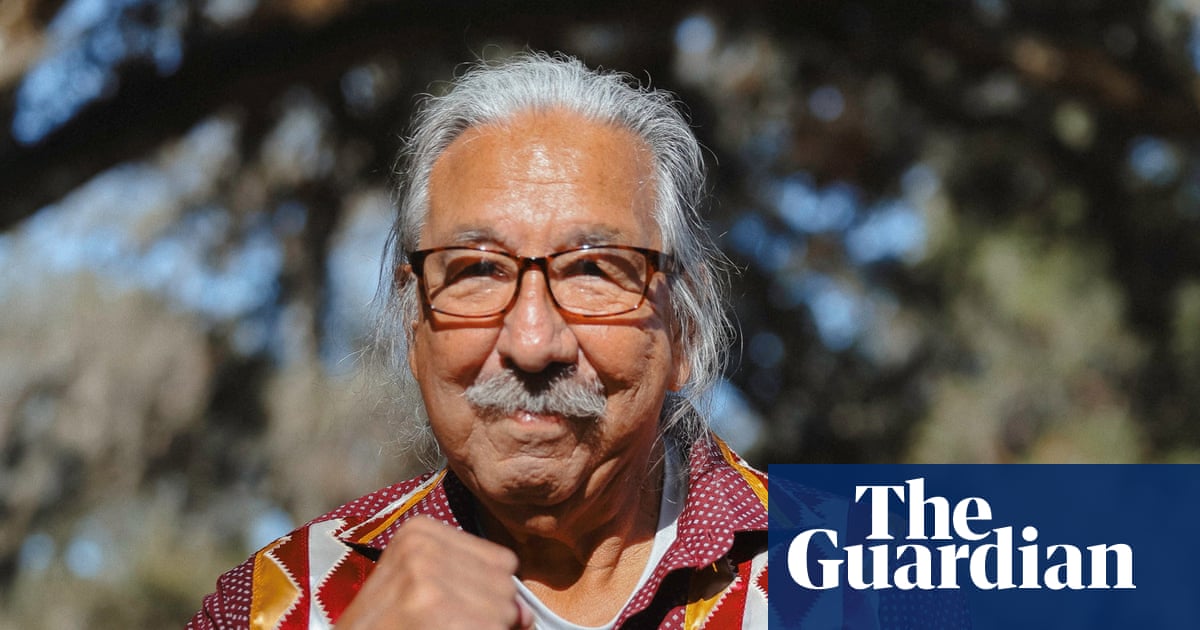
On 20 January 2025, with 14 minutes remaining in his term as president, Joe Biden commuted the life sentence of Leonard Peltier, after years of pressure to release a figure seen by many as the longest-serving political prisoner in the US. The Indigenous activist, a leader within the American Indian Movement (Aim) and an icon of Native American resistance, served nearly 50 years in prison for allegedly killing two FBI agents during a shootout on the Pine Ridge reservation in South Dakota, in 1975 – killings he has always denied, prosecuted in a railroaded trial widely seen as corrupt. Outside the Florida prison where Peltier was being held that morning were several of the many activists and lawyers who fought for his release, as well as film-makers David France and Jesse Short Bull.
The two directors’ long-gestating documentary on Peltier’s fight for justice was set to premiere just a week later at the Sundance film festival with a very different ending, the octogenarian still awaiting a chance to return home to the Turtle Mountain Band of Chippewa reservation in North Dakota. That morning, there was “a sinking feeling that it wasn’t going to happen”, France said. When it did, while the cameras rolled, the line of supporters erupted in joy for a commutation that allowed Peltier to serve the rest of his consecutive life sentences on house arrest, though it did not pardon him – not quite justice, but a victory so uncertain and so hard-fought, over more than half a lifetime, that I have cried every time I’ve rewatched it.
Free Leonard Peltier, out on Netflix for Indigenous Peoples’ Day in the US, makes clear why, as Peltier put it to me over Zoom from his new home, “I just wasn’t going to give up.” Over 110 minutes, Short Bull and France retrace not only what happened that day at Pine Ridge, but the long arc of Indigenous activism in the US, from Peltier’s childhood resisting Native boarding schools, the government-run institutions used to forcibly separate Native families and force assimilation, to Aim’s occupation of the Bureau of Indian Affairs (BIA) in 1972 and the many decades of work to free Peltier. For years, as more evidence of railroaded justice emerged, Peltier’s name became synonymous with Indigenous resistance, another abuse in a long chain of abuses by the US federal government. Peltier joined the movement in the 1960s, after experiencing anti-Native police brutality while working at a power plant on the Navajo Nation, and participated on Aim’s “trail of broken treaties” caravan to Washington.
He served as a security guard when Aim members occupied the BIA building, where things devolved after the discovery of paperwork confirming future plans to use tribal lands for mining. Such tribal lands included Pine Ridge, which held some of the richest uranium deposits in the United States. Peltier arrived on the reservation during a tense and dangerous time, as a corrupt tribal government, led by Dick Wilson and enforced by his BIA-backed private “goons” (Guardians of the Oglala Nation), clashed with tribal members and Aim, sent to help defend residents from routine violence; one former resident recalls in the film that there were 68 murders in Pine Ridge during that time, and no arrests.
The day of the shootout, in which a militarized FBI – archival footage shows dozens of tanks and military-style assault weapons – traded fire with a handful of Aim security members, Wilson unilaterally ceded one-eighth of the reservation to the federal government. We weren’t going to try to solve the case. It wasn’t our job to figure out who pulled the trigger – we know it wasn’t Leonard.” What became clear through extensive archival research was that “people knew then that this was all about land.
And none of that had been brought out before in the telling of Leonard’s story or the telling of the American Indian Movement. It’s all about the land.” Almost every film participant, as well as France, Short Bull and Peltier himself, assert that given the land deal, the FBI at minimum escalated the violence that day, which killed agents Jack Coler and Ronald Williams, as well as Aim member Joe Stuntz, if not outright staged it. (No arrest was ever made in Stuntz’s death.) The film’s second half details the numerous miscarriages of justice after Peltier, who escaped that day and hid out for a time in an RV loaned by Marlon Brando, was arrested in Canada. The litany of dubious maneuvers used to incarcerate Peltier plays like a who’s-who of prosecutorial misconduct on every level: Peltier’s extradition was secured via fabricated testimony from a “girlfriend” he had never met, and who later recanted, citing coercion; he was tried separately from his co-defendants Dino Butler and Bob Robideau, who were allowed to argue self-defense and acquitted, in a court presided over by a known racist judge in North Dakota; the FBI’s limited evidence, claiming with certainty that Peltier shot the two agents at point-blank range, was later revealed to be unreliable.
Extract — continue reading at the source.