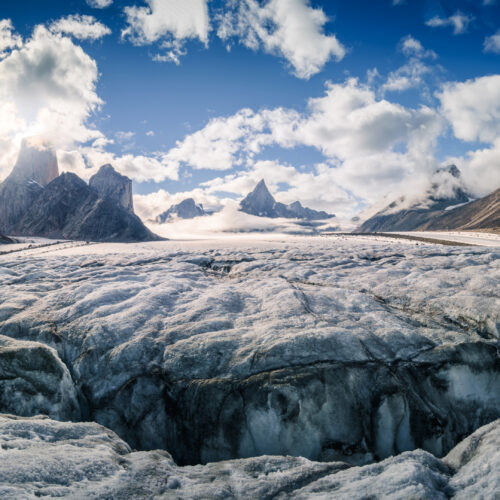
Barnes Ice Cap sits on the central plateau of Baffin Island, in the Canadian Arctic. It is the last surviving fragment of the Laurentide Ice Sheet, the largest of the Pleistocene ice sheets, which at its peak buried most of Canada under two miles of ice and locked away around 80 meters of sea level. That remnant has now yielded direct physical evidence that ice sheets might have reversed their retreat and started to grow again thousands of years ago.
In a recent Science study, researchers show that the Laurentide reached its smallest size about 3,600 years ago, then started re-expanding roughly 2,000 years ago, which the team interprets as the opening move of the next glaciation. Apparently, this brand-new ice age was on its way until about 1960, when human-caused climate warming reversed it. As that enormous dome thinned through the Holocene, its margin withdrew up onto Baffin Island, and what’s left today is the deflated core of something that was once two miles thick.
The reason Barnes can testify about its own history, Young explains, comes down to the temperature at its base. Most glaciers are warm-based, meaning meltwater at the bed lets them slide, and sliding ice grinds up everything beneath it, erasing the record. Barnes is cold-based, and thus frozen directly onto the bedrock beneath it, which prevents it from sliding.
It’s sort of just stuck to what it’s on,” Young says. This stuck ice preserves what’s beneath instead of eroding it. As the Laurentide retreated across the plateau, tundra plants colonized the newly bare ground.
When the ice came back later, it simply smothered them in place and held them there, intact, for two millennia. To pinpoint the exact moment of this turnaround, Young’s team used two independent dating methods.
Extract — continue reading at the source.