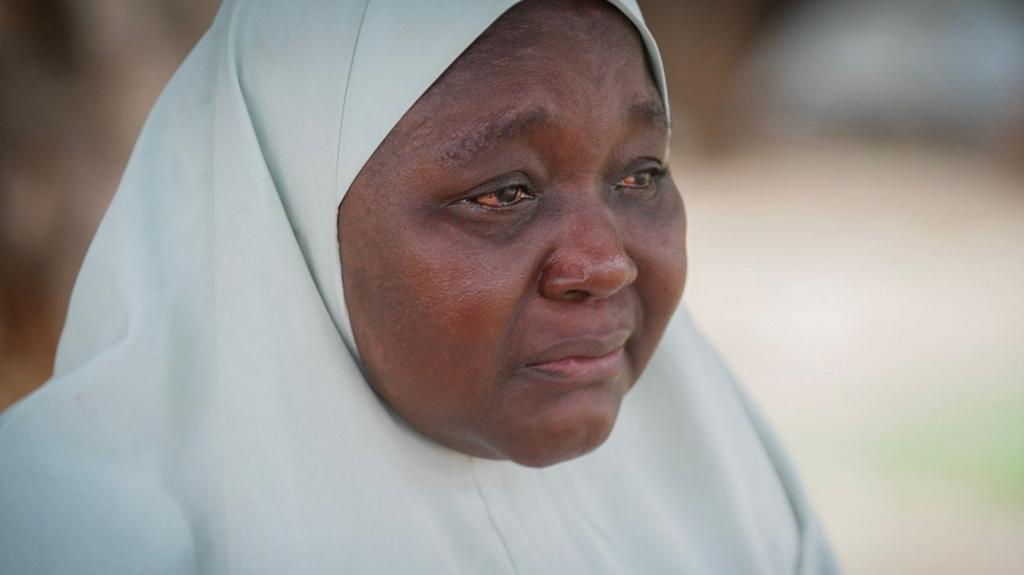
"If you ran into a room, they set the room on fire," says Fatima, describing a recent attack on her village in Zamfara, north-western Nigeria. "If you came out and started running, they shot you." The gunmen, who struck at 02:00, split into groups to surround residents: one at the village entrance, one in the centre and one at the back. "They opened fire without a care in the world, shooting indiscriminately," the 55-year-old quietly tells the BBC World Service.
It was one of many attacks that have caused havoc in the mainly Muslim community where residents live in fear of being kidnapped for ransom. Fatima explains how the raids unfold: "You could have 100 motorcycles, and each one could be carrying three people." About 70 people, including children, were killed from the village of Bia Buki in June, according to Fatima. She describes how the attackers also targeted villagers as they fled and children were injured falling into ditches.
Among the dead were her husband and six of his seven siblings. Fatima is one of an estimated 800,000 Nigerians who the UN says have been displaced in the country's north-west. One of the main reasons people have left their homes is violence.
Some attacks have been carried out by militant Islamist groups, but the majority in this region are by gangs, locally referred to as bandits, who often move around on motorcycles and attack quickly then ride away, escaping before security forces arrive. Thousands of people have joined government-backed vigilante groups to fight, and the BBC spoke to one who said his armed group had killed many bandits. But the gangs keep attacking in what appears to be a deteriorating pattern of violence and abductions that is spreading southwards.
Fatima says when the bandits attacked her home, she ran into the nearby forest with other villagers to hide: "The forest became our sanctuary. We ran with our kids, if you couldn't find your child you'd take your neighbour's child." She says people slept in the forest before moving on to the state capital, Gusau, "where we found a little bit of peace". Fatima now lives in an informal camp in Gusau with her seven children, who are aged between nine and 30.
Dozens of women sit in groups on the dusty ground of the makeshift compound, many wearing brightly coloured hijabs. More than 1,000 people are here, she believes. Conditions are tough with "no proper place to even lay your head".
Extract — continue reading at the source.