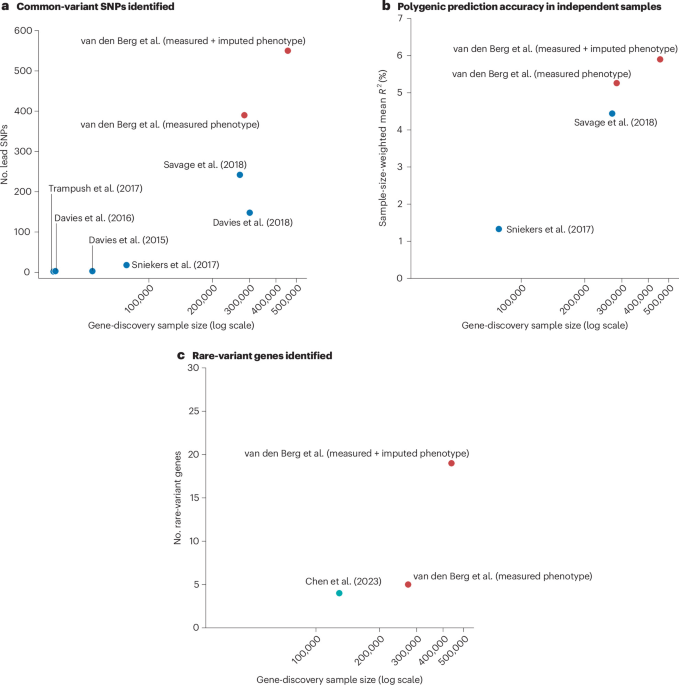
A study imputes fluid intelligence from correlated variables to expand the UK Biobank analysis sample from around 285,000 to 455,000 individuals, boosting discovery of both common and rare genetic variants and charting a roadmap for imputing phenotypes while minimizing bias in future gene-discovery studies. This is a preview of subscription content, access via your institution Access Nature and 54 other Nature Portfolio journals Get Nature+, our best-value online-access subscription Receive 12 print issues and online access Prices may be subject to local taxes which are calculated during checkout Okbay, A. et al. Genet. 54, 437–449 (2022).
Article CAS PubMed PubMed Central Google Scholar Abdellaoui, A., Yengo, L., Verweij, K. Genet. 110, 179–194 (2023). van den Berg, D. Genet. https://doi.org/10.1038/s41588-026-02787-5 (2026).
Article PubMed PubMed Central Google Scholar Fawns-Ritchie, C. & Deary, I. PLoS ONE 15, e0231627 (2020). Psychiatry 20, 183–192 (2015).
Psychiatry 21, 758–767 (2016). Psychiatry 22, 336–345 (2017). Genet. 49, 1107–1112 (2017).
Genet. 50, 912–919 (2018). Nature 603, 858–863 (2022). Genet. 55, 927–938 (2023).
Genet. 55, 2082–2093 (2023). Behavioral Decision Making Area, Anderson School of Management, University of California Los Angeles, Los Angeles, CA, USA Human Genetics Department, David Geffen School of Medicine, University of California Los Angeles, Los Angeles, CA, USA National Bureau of Economic Research, Cambridge, MA, USA The author declares no competing interests. Imputation of fluid intelligence to increase power for gene discovery.
Extract — continue reading at the source.