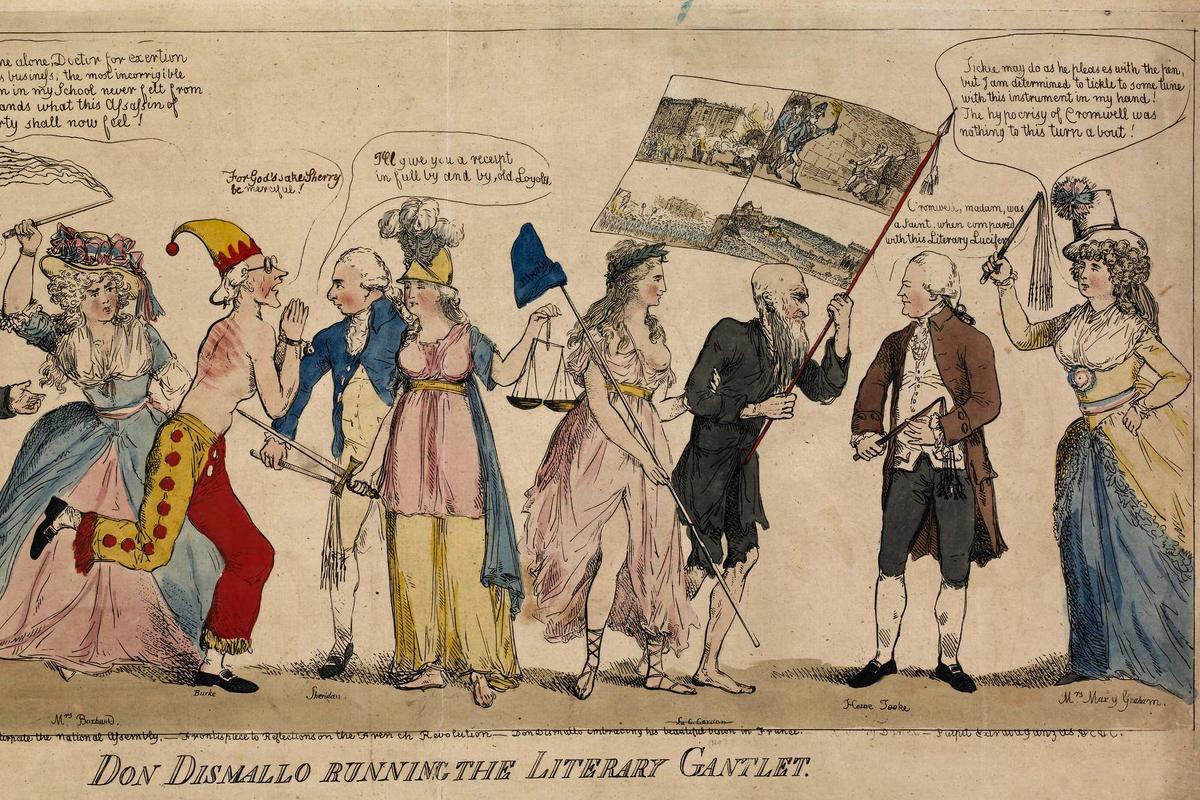
Don Dismallo Running the Literary Gantlet (1790); Edmund Burke is portrayed as a fool, and Catharine Macaulay is shown at the far right. Courtesy the British Museum, London In 1706, an English woman visited her friend, Katherine. Katherine’s husband, Francis Atterbury, was a prominent politician and bishop.
Upon hearing that Francis had just finished writing his sermon, Katherine’s friend asked if she could take it home to read it. Francis graciously agreed, no doubt expecting to receive some compliments from the lady. But his sermon was promptly returned to him by the woman with copious criticism and notes for its improvement.
Francis was shocked: he complained to a friend that the lady lacked a ‘decent manner’ and that she was ‘offensive and shocking in her expressions’. He admitted: ‘I dread to engage her.’ This ‘indecent’ and ‘shocking’ woman was Mary Astell (1666-1731). Today, she is best known as England’s first feminist, whose paradoxical mix of conservative politics and pioneering feminism has long puzzled scholars.
By 1706, Astell was no doubt used to being called offensive, irritating and impolite. She wrote most of her partisan pamphlets in the first decade of the 18th century, always studded with sharp attacks on men she disagreed with (often, but not exclusively, those on the side of the Whig liberals, the most famous of which was John Locke). One of the pamphleteers she attacked, James Owen, dismissed her as overly angry, zealous and ‘virulent’ – a dismissal that meant that he did not have to actually engage with her sharp and difficult arguments.
More than half a century later, another politically active woman received similar treatment. The historian and political theorist Catharine Macaulay (1731-91) had penned a sharp pamphlet attacking Edmund Burke, who remains widely received as the ‘father’ of modern conservatism and the first major proponent of organised political parties. Macaulay had taken issue with Burke’s now-famous defence of party, Thoughts on the Cause of the Present Discontents (1770).
Instead of dealing with her critique head on, Burke wrote to his friend that ‘the Amazon is the greatest champion amongst them … no heroine in Billingsgate can go beyond the patriotick scolding of our republican Virago.’ Invoking the image of the fierce female warrior and of the loud, masculinised woman, he ridiculed Macaulay, but not without a sense of awe. Much like Atterbury, Burke admitted he was ‘afraid to answer her’. But Burke’s dismissal of Macaulay was not just rudeness – it was entirely consistent with his broader vision of what partisanship should look like, and who should be allowed to practise it.
Extract — continue reading at the source.