Nerve nets are considered the evolutionarily oldest form of nervous system. How such networks develop and how complex nervous systems become fully functional is largely unknown. In a phylogenetically ancient animal, the freshwater polyp Hydra, we demonstrate how a nerve net consisting of distinct neuronal populations is precisely replicated over the course of asexual proliferation by budding.
During this process, precursor cells first accumulate at the site of the emerging neural network, followed by a stepwise formation of functional neural circuits composed of distinct neuronal populations. These circuits become arranged according to an accurately controlled spatiotemporal pattern and take control of behaviors independently of the existing parental network. Since similar processes also govern the formation of more complex nervous systems in other invertebrates and vertebrates, we suggest that the basic requirements for a neuronal network to replicate were already in place at the beginning of the evolution of the nervous system.
Nerve nets are considered the evolutionarily oldest organization of the nervous system, the major organ system responsible for processing information and coordinating animal behavior1,2. How diverse and complex nervous systems evolved from the simple nerve nets over the course of 600 million years remains one of the unresolved questions in evolutionary and comparative neurobiology. How do neurons form functional units to orchestrate simple behaviors, and what are the minimal requirements for a functional neuronal circuit?
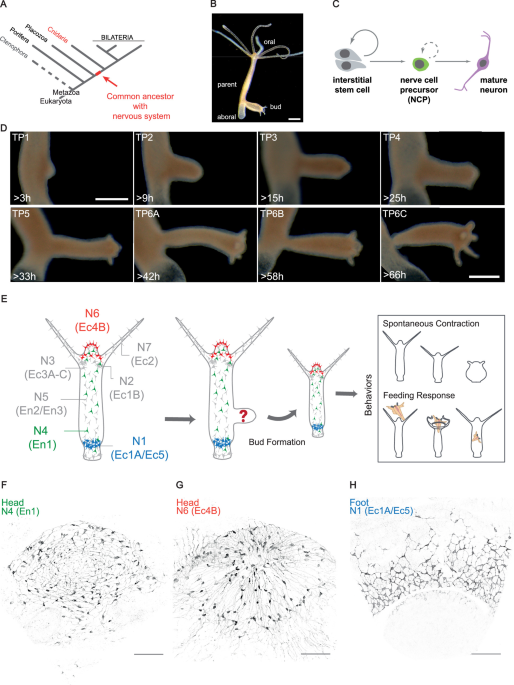
Addressing these questions requires a model system that is both experimentally traceable and evolutionarily informative. Cnidarians, members of the phylum that diverged from their sister group Bilateria (Fig. 1A) over 650 million years ago, occupy a key phylogenetic position for investigating the evolution of nervous systems3,4. Molecular studies provided solid evidence that the first neurons and nervous systems appeared in the common cnidarian-bilaterian ancestor5 and cnidarian nervous systems operate using remarkably similar molecular machinery as the bilaterian ones6.
Hence, cnidarian nerve nets have great potential for revealing the fundamental principles of nervous systems and the evolution of their complexity6,7,8. Across animal phyla, neurogenesis, i.e., the process by which new specialized neurons are generated from neural stem cells, is fundamental for nerve net development and growth. In contrast to most model organisms9, neurogenesis and nerve net formation in the freshwater cnidarian Hydra (Fig. 1B) are not restricted to embryogenic development but occur continuously in adult polyps (Fig. 1C).
This allows lifelong homeostasis and renewal of the nerve net in a polyp10,11,12. Another unique feature of Hydra is the polyp’s asexual reproduction (Fig. 1B, D), where an outgrowth from the parent’s body, termed a bud, develops into a clonal copy of the parent polyp and separates to become an independent polyp within just 60–70 h13. During this development, both the ectoderm and the endoderm remain as adjacent epithelial layers, where the endoderm of the bud is a physical continuation of the parental polyp’s endoderm14.
Extract — continue reading at the source.