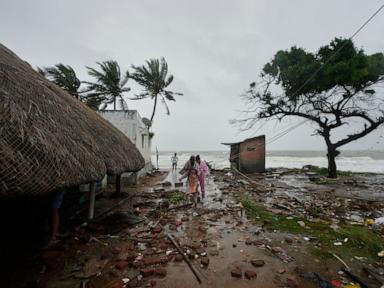
A cyclone that powered up over unusually warm ocean waters is taking aim at a section of India’s coastline that’s dense with billions of dollars in data centers, underscoring the threats to infrastructure in a world where extreme weather is becoming mo... BENGALURU, India -- A cyclone that powered up over unusually warm ocean waters is taking aim at a section of India's coastline that's dense with billions of dollars of investment in data centers, underscoring the threats to infrastructure in a world where extreme weather is becoming more frequent. Cyclone Arnab roared ashore Wednesday in eastern India with powerful winds and heavy rain, killing three people and inundating roughly 200,000 acres of cropland, according to authorities.
Electricity poles have been uprooted and roads blocked. Heavy rainfall emerged as the biggest threat to areas inland as the storm's wind speeds weakened. Meteorologists said that unusually high temperatures across the Bay of Bengal helped fuel Arnab.
Its arrival on a coastline where billions of dollars are being invested in data centers underscores how extreme weather threatens both existing livelihoods and the infrastructure intended to drive future growth, said climate experts. It will likely take days or weeks for full damage estimates to be calculated. Unusually high temperatures across the Bay of Bengal, an already warm atmosphere and heat stored below the surface helped fuel Arnab, according to K.J.
Ramesh, a former director general of the Indian Meteorological Department. The unusually warm waters also helped the storm strengthen rapidly, according to Akshay Deoras, a weather expert at the University of Reading in the United Kingdom. He said cyclones are part of natural weather patterns but warming from human-caused climate change can amplify their rainfall.
The storm follows India’s weakest southwest monsoon since 2015. A strong El Niño weather phenomenon combined with an already warming climate has resulted in sparse rainfall from June through September, according to weather experts. Districts across several Indian states have declared droughts and southern and eastern India suffered particularly large deficits.
Intense downpours offer little reassurance when rain falls unevenly. Heavy rainfall can also run off hardened, dry ground, rather than being absorbed. Past extreme weather events have already taken a devastating toll on India.
Extract — continue reading at the source.