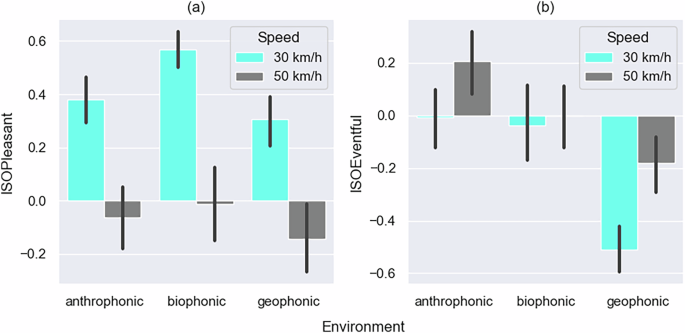
Road traffic substantially shapes urban acoustic environments and their perception. While debates on urban speed limits mainly focus on safety and emissions, less is known about their perceptual effects on urban soundscapes. To evaluate these effects, a laboratory study in virtual reality was conducted in which 34 participants completed rating and performance tasks within a simulated urban green space.
Traffic noise under two speed limit conditions (30 km/h and 50 km/h) was combined with three types of non-traffic acoustic environments (anthrophonic, geophonic, and biophonic). In a first experiment, perceived affective quality ratings were collected to determine the soundscape dimensions pleasantness and eventfulness. In a second experiment, participants completed a 2-back task under both speed limit conditions, after which subjective workload was assessed using the NASA Task Load Index.
Both speed limit and environment type significantly affected pleasantness and eventfulness, with speed limit exerting a stronger influence on pleasantness and environment type a stronger influence on eventfulness. Although perceived workload was slightly higher in the 50 km/h condition, the effect was not significant. These findings highlight the importance of perceptual factors in shaping urban acoustic well-being.
Environmental noise constitutes a relevant environmental stressor with multiple impacts on humans, including effects on mood1, well-being2, working performance3, children’s learning and performance4, and social behavior5. In this context, the majority of research on noise effects has focused on harmful and detrimental consequences for health6. More recently, however, there has been growing discussion of the possibility that certain acoustic conditions may also be health-promoting2.
Accordingly, the planning of acoustically coherent public spaces is increasingly recognized as an important goal that extends beyond the mere reduction of unwanted sound7. Since the publication of the European Environmental Noise Directive (END) in 20028, preserving environmental noise quality in areas where it is good has become a key responsibility for national environmental agencies and municipalities. Specifically, the END requires agglomerations to identify quiet areas and to protect public parks and other tranquil spaces from increases in noise.
A few years later, Gidlöf-Gunnarsson and Öhrström9 demonstrated that access to nearby green areas reduces noise annoyance at home, highlighting the important role of urban green and quiet spaces. More recent research confirms the value of green areas in urban settings for mitigating road traffic noise annoyance, with Kawai et al.10 quantifying this moderating effect as equivalent to a 4 dB reduction in sound pressure level. Additionally, Dopico et al.11, in a cross-sectional field study in Zurich, Switzerland, found a significant negative association between neighborhood green space and stress biomarkers, further supporting the importance of public green areas for well-being and public health.
Extract — continue reading at the source.


