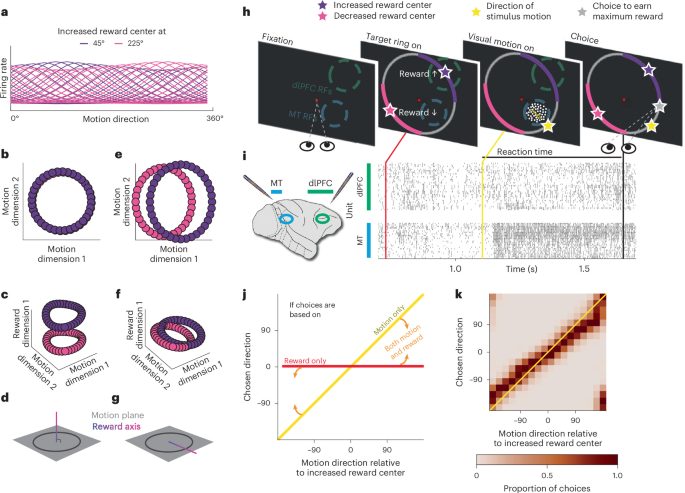
Neurons throughout the brain encode essentially everything, so why have distinct areas? We proposed that areas format different information sources differently, implying their computational role. Here we compared the middle temporal (MT) area, involved in visual motion perception, and the dorsolateral prefrontal cortex (dlPFC), implicated in decision-making and reward.
In a task that required monkeys to combine motion and reward information, both regions encoded both motion and reward, but formatted differently. Area MT represented them separably, whereas the dlPFC combined them in a decision-related format. A recurrent network model trained to reproduce that formatting predicted a distinct effect of stimulating those areas.
Consistent with predictions, MT stimulation biased choices whereas dlPFC stimulation produced ‘winner-take-all’ outcomes. Our findings suggest that a modular structure flexibly reformats information to enable complex behaviors. Animals capable of complex behaviors tend to have more distinct brain areas than simpler organisms, and artificial networks that perform many tasks tend to self-organize into modules1,2,3.
This suggests that different brain areas serve distinct functions supporting complex behavior. Many experiments demonstrate a functional segregation across different brain areas and pathways4, yet the responses of individual neurons reflect multiple sensory, cognitive and/or motor processes. A recent set of studies indicates that essentially anything that an animal senses, knows or does can be decoded from neural activity in any brain area5,6,7.
The goal of our study was to understand what the representation of information from different sources can tell us about the role of a neuronal population in behavior. For example, in the visual cortex, MT neurons are tuned for visual motion direction8,9,10,11,12 and their responses are modulated by reward expectation and other cognitive processes13,14,15,16. However, the presence of signals related to both motion and reward does little to identify the role of these neurons in behavior.
The same distributions of tuning and modulation are consistent with multiple ways of formatting information in the population (which is sometimes called representational geometry or neuronal population geometry17,18). Neuronal population geometry refers to the representation of stimulus, task or motor information in a high dimensional space where the response of each neuron represents one dimension19,20,21,22,23,24,25,26. In such a space, neuronal population responses to a circular variable like motion direction trace out a circle.
Extract — continue reading at the source.


