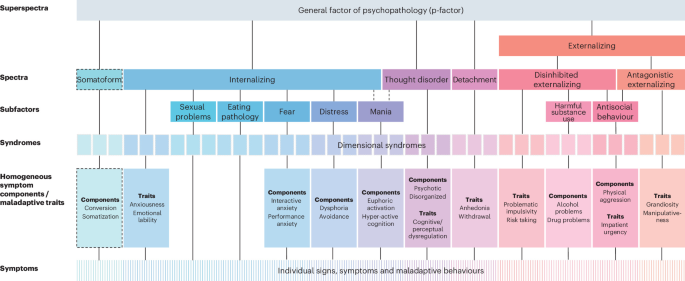
Quantitative models of psychopathology and computational psychiatry are two distinct approaches that have generated optimism about advancing mental health research. Among quantitative models, the Hierarchical Taxonomy of Psychopathology (HiTOP) has improved clinical description by organizing psychopathology according to patterns of symptom covariation. In parallel, computational psychiatry seeks to identify the neurocognitive processes that might explain psychopathology and impact clinical and functional outcomes.
In this Perspective, we highlight points of convergence and complementarity between HiTOP and computational psychiatry and argue for a closer integration. Specifically, we propose that HiTOP provides an empirically grounded model of psychopathology that improves the specificity and validity of modern computational findings, whereas computational psychiatry helps to explain how HiTOP dimensions relate to underlying neurocognitive processes. We conclude by considering barriers to integration, such as limited cross-field collaboration, challenges posed by multimodal data and unresolved questions about how computational and biological measures should inform the future development of the HiTOP model.
This is a preview of subscription content, access via your institution Receive 12 digital issues and online access to articles Prices may be subject to local taxes which are calculated during checkout Kendell, R. & Jablensky, A. Distinguishing between the validity and utility of psychiatric diagnoses. Psychiatry 160, 4–12 (2003).
Haslam, N., Holland, E. & Kuppens, P. Categories versus dimensions in personality and psychopathology: a quantitative review of taxometric research. J., Viechtbauer, W. & Kuppens, P.
Dimensions over categories: a meta-analysis of taxometric research. Med. 50, 1418–1432 (2020). Normal versus pathological mood: implications for diagnosis.
Psychol. 15, 179–205 (2019). Longitudinal assessment of mental health disorders and comorbidities across 4 decades among participants in the Dunedin Birth Cohort Study. Article PubMed PubMed Central Google Scholar Kessler, R.
Extract — continue reading at the source.


