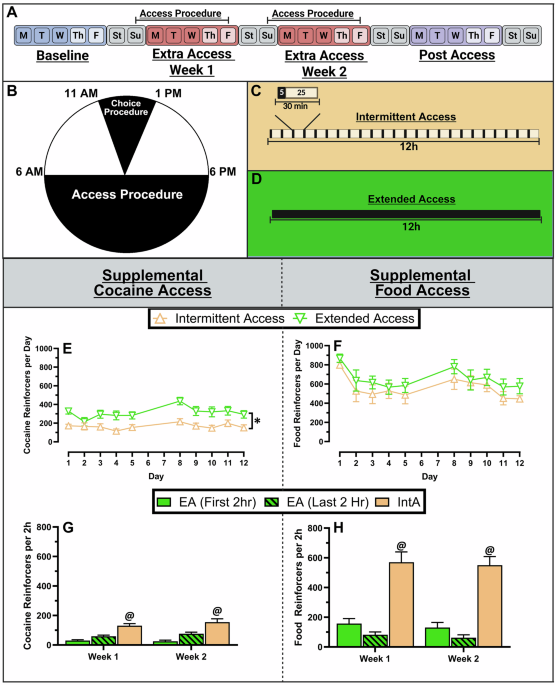
Cocaine use disorder (CUD) can be modeled preclinically using different temporal cocaine self-administration access conditions. For example, intermittent-access (IntA) procedures typically use cycles of brief (e.g., 5 min) cocaine-access periods separated by longer (e.g., 25 min) time-outs to generate bouts of high-rate cocaine self-administration. Conversely, extended-access (EA) procedures use longer (e.g., 6–12 h) cocaine access periods to generate sustained and progressive increases in cocaine self-administration.
Although both IntA and EA procedures increase cocaine breakpoints and demand, the behavioral effects are hypothesized to be mediated through different mechanisms. Preclinical cocaine choice procedures may have utility in improving our mechanistic understanding of how different cocaine access conditions alter cocaine reinforcement. The present study compared the effects of IntA and EA cocaine and food on cocaine-vs-food choice.
Male and female Long Evans rats initially responded under a cocaine-vs-food choice procedure. Rats were then allocated into one of three experimental groups while retaining daily cocaine choice sessions: (a) daily supplemental 12 h IntA sessions (5 min ON: 25 min OFF), (b) daily supplemental 12 h EA sessions, or (c) no supplemental access. IntA cocaine resulted in higher rates of cocaine self-administration; however, EA cocaine resulted in larger daily cocaine intakes.
Both IntA and EA cocaine significantly decreased cocaine choice, with EA producing greater reductions in cocaine choice than IntA. Although both IntA and EA food resulted in equivalent food-maintained behavior, IntA food increased cocaine choice, whereas EA food trended towards an increase in cocaine choice. Overall, the relative openness of an economy seems to be an important determinant of reinforcer efficacy in a choice context.
Cocaine use disorder (CUD) is characterized and diagnosed as a maladaptive allocation of behavior towards cocaine at the expense of alternative non-drug reinforcers such as family or employment; however, the environmental or pharmacological factors that lead to this behavioral misallocation are poorly understood [1,2,3]. Clinical evidence suggests that people who use cocaine display differential patterns of drug self-administration depending on CUD severity [4,5,6]. For example, one pattern of cocaine self-administration in humans has been characterized as “binge-crash,” with large cocaine intake over short periods of time followed by longer abstinence pauses [7, 8].
Another reported cocaine self-administration pattern in humans has been characterized as a progressive increase in cocaine self-administration over time [8, 9]. To understand how different temporal patterns of cocaine self-administration alter cocaine reinforcement, different animal models have been developed. For example, an intermittent access (IntA) procedure allows subjects to cycle through short periods (e.g., 5 min) of cocaine access followed by an abstinence period (e.g., 25 min time out) to model the early stage “binge” patterns of cocaine self-administration (for review, see [10,11,12].
Extract — continue reading at the source.