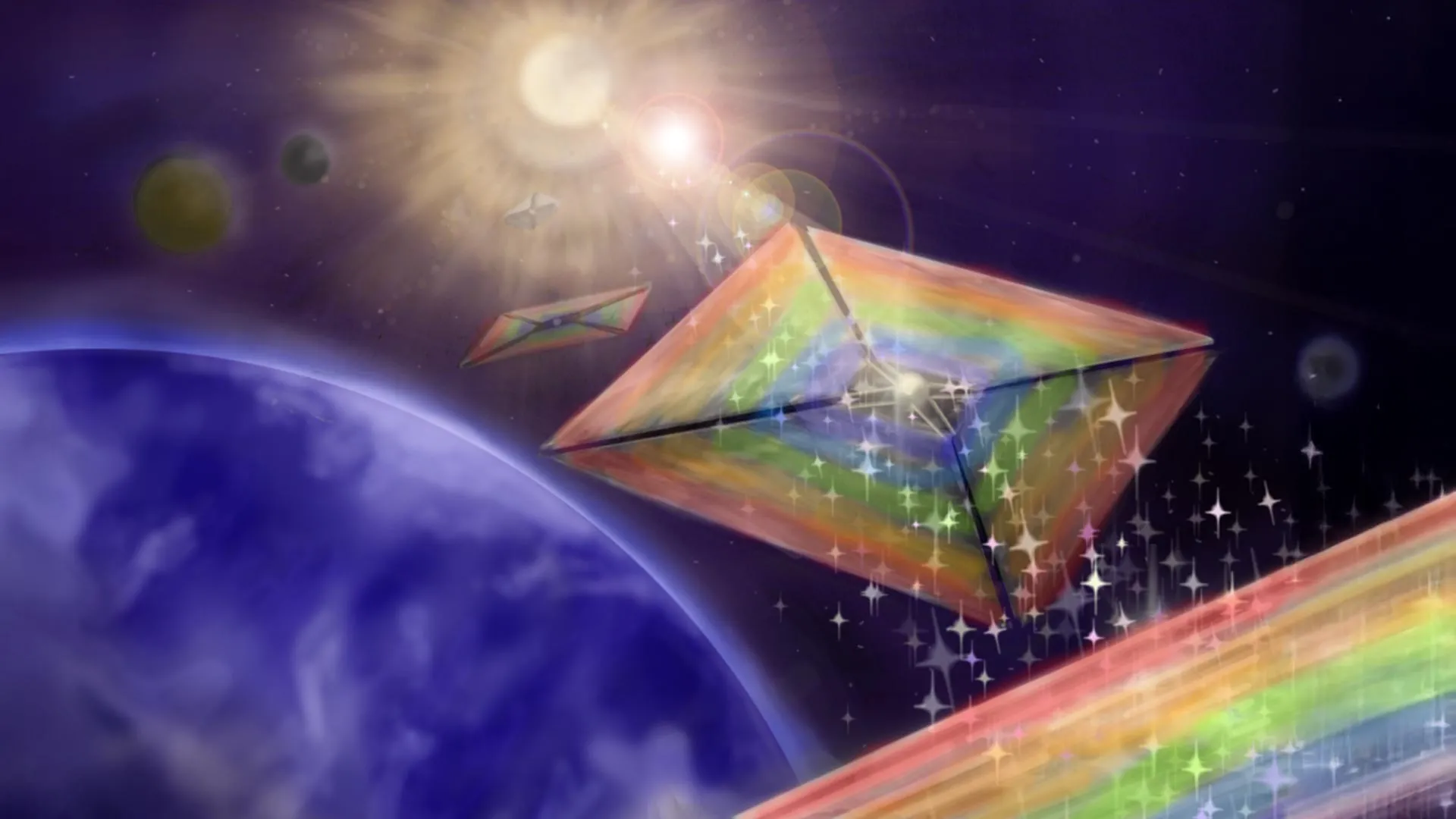
Reaching another star within a practical amount of time will require something far more capable than chemical rockets. One of the leading ideas is a solar sail, a large reflective structure that can be pushed by light. If extremely powerful lasers are aimed at such a sail, they could accelerate it to speeds well beyond what current propulsion systems can achieve.
But there may be an unexpected problem once a lightsail begins traveling at a significant fraction of the speed of light. According to a new paper on arXiv by Chao Shen and Jiaze Li of the Harbin Institute of Technology, the same light used to propel the sail could eventually produce a drag effect. The researchers separate the forces produced by photons striking a solar sail into three categories.
The strongest contribution comes from incident light (that raw momentum of the photons hitting the sail). Next is specular reflection (momentum imparted when photons bounce perfectly off the sail). The weakest contribution comes from diffuse scattering (momentum from photons that are absorbed by the sail then reemitted in random directions).
At relatively low speeds, these effects all contribute to pushing the sail forward. The situation becomes much more complicated once the spacecraft reaches relativistic velocities. As the sail races away from the laser source, the light reaching it undergoes an increasingly strong Doppler shift.
The frequency of the incoming light decreases, reducing the amount of thrust produced by all three components. As a result, continued acceleration becomes progressively less efficient. The faster the sail travels, the harder it becomes for the laser to keep increasing its speed.
The situation changes even more dramatically once the lightsail reaches about 75% of the speed of light. When Scattered Light Starts Creating Drag At that speed, relativistic light aberration becomes important. From the viewpoint of a stationary observer on Earth, diffusely scattered light begins to be directed forward, toward the direction in which the sail is traveling.
Extract — continue reading at the source.