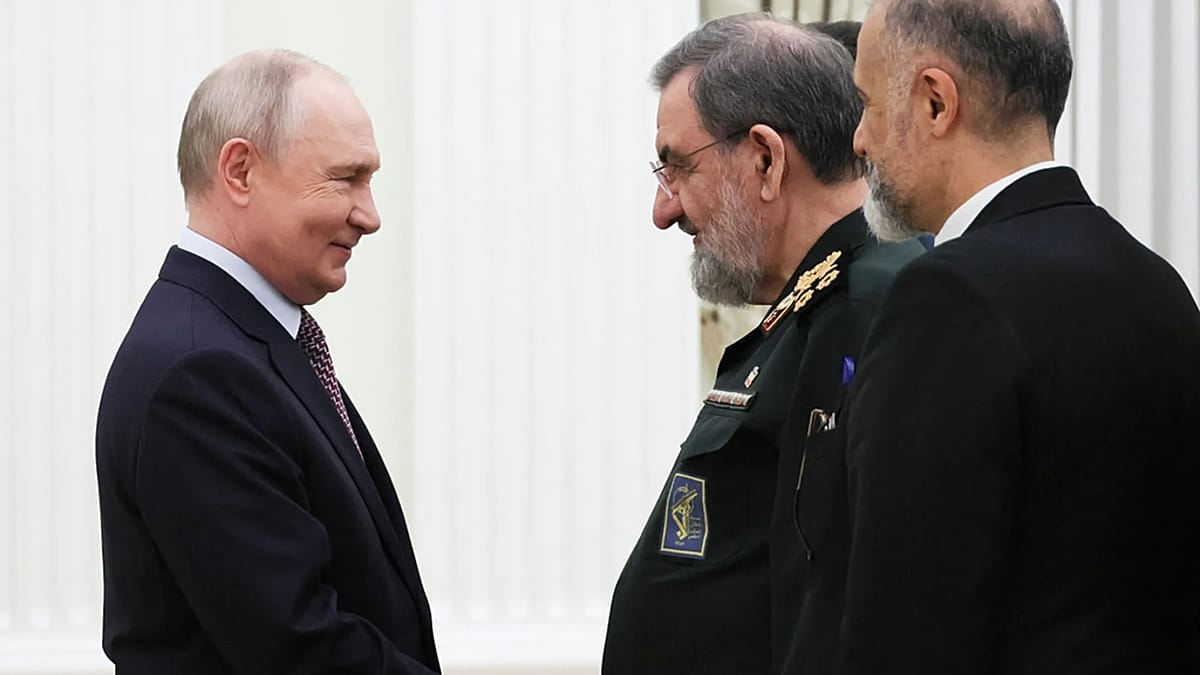
Iran’s Supreme National Security Council Secretary met Russian President Vladimir Putin in Moscow on Thursday, where he delivered a personal message from Iran’s Ayatollah Mojtaba Khamenei regarding the Iran war and discussed what both sides called “strengthening ties”. Iran’s top security official described the meeting as an "extremely important exchange of views," which covered "the post-war situation and regional security.” Russia has been a long-standing supporter of Iran, purportedly supplying Tehran with intelligence and equipment during the war. Tehran has previously backed Russia in its all-out invasion of Ukraine, and provided its Shahed drone technology.
Moscow has since cloned it into its domestically-made Geran UAVs, which it commonly uses in its daily strikes on infrastructure and civilian targets in Ukraine. The meeting, which was not announced in advance, follows the Russian president's meeting with his Iranian counterpart Masoud Pezeshkian in Moscow during a summit of the Gas Exporting Countries Forum last week. The content of Khamenei’s message to Putin was not made public, Iranian state broadcaster IRIB reported.
"The construction of gas pipelines from Russia to Iran was discussed" during the meeting with Putin, Rezaei stated. He explained that the project aims to help Tehran "address its gas shortages, while also facilitating the sale of Russian gas to neighbouring countries." Although Iran is a major producer of natural gas, it has long suffered from shortages of the fuel, a crisis that has only intensified since the onset of the Iran war in late February. According to Tehran, during the most intense phase of the war — which lasted nearly 40 days — the US and Israel launched strikes against critical Iranian infrastructure, including gas processing plants.
Iran responded by attacking what it said were US military facilities and other interests in the broader Middle East region. Regional governments, witnesses on the ground and Euronews journalists reported the strikes also hit civilian and infrastructure targets. Both sides also imposed concurrent blockades of the Strait of Hormuz, a key waterway for the world's gas and oil trade.
In early October, Putin stated that Russia is prepared to act as a mediator to help end the war. Moscow has not acted as an intermediary in the talks. Pakistan and Qatar have so far served as the main mediators.
Rezaei noted that Putin emphasised the need for regional security mechanisms and asserted that "any interference by external powers" in resolving the situation in the Middle East is unacceptable. Russia has delayed, deflected to Kyiv or otherwise rejected all attempts to broker an end to its ongoing war in Ukraine, now well into its fifth year. According to Rezaei, the meeting also addressed progress on key bilateral infrastructure projects.
Extract — continue reading at the source.