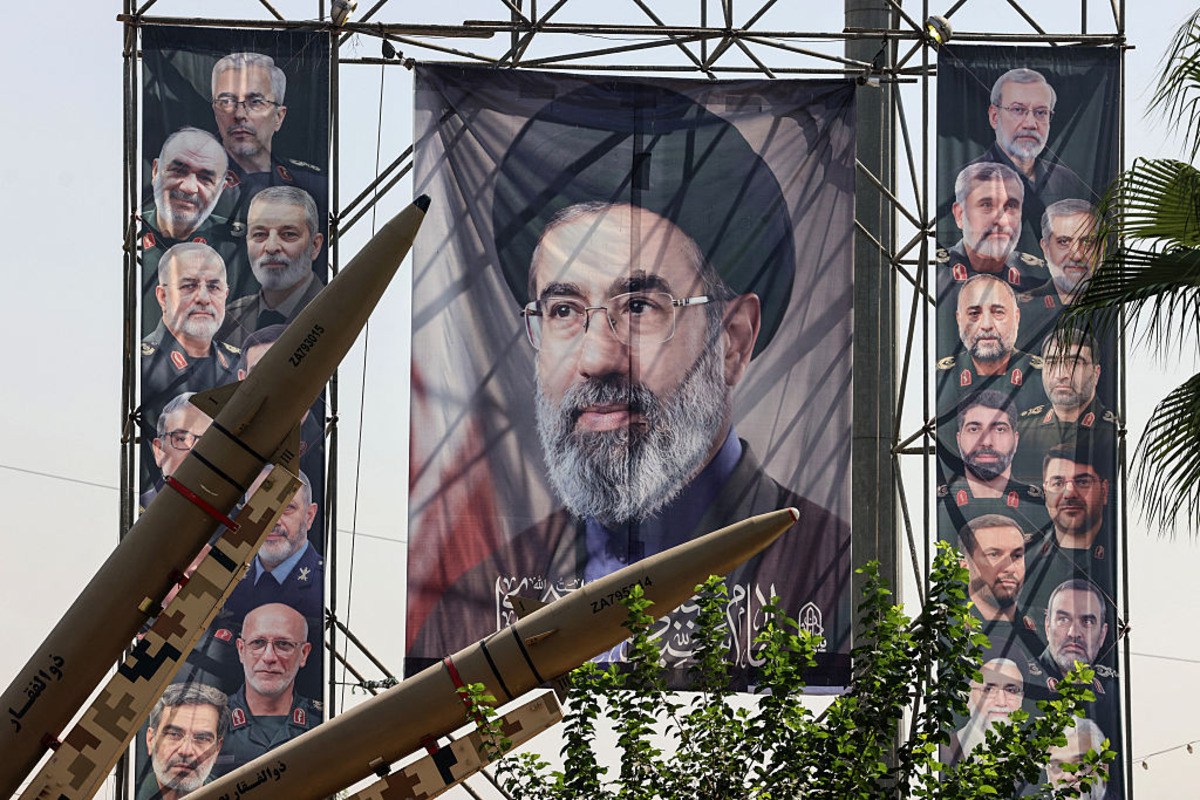
President Donald Trump created quite a stir when he suggested Iranian missiles raining down on California's two largest cities could be "a small price to pay for keeping the world safe," but experts say Iran doesn't have the weapons needed to launch long-distance, devastating strikes on LA and San Diego. "Let them take out Los Angeles, let them take out San Diego," Trump told a crowd gathered in Nebraska on Monday. Against a backdrop of outcry from California officials, the White House later said Trump was "clearly stating U.S. cities would have been threatened if a nuclear Iran hadn't been stopped," referencing the U.S. government's rationale for attacking Iran in brief strikes last year and for starting the seven-month-long war against Tehran in February.
"Iran does not currently have a missile with sufficient range to reach the continental U.S.," Sam Lair, a fellow with the Foreign Policy Research Institute (FPRI), told Newsweek. Analysts say Iran's attempted missile attack on Diego Garcia, the island in the central Indian Ocean hosting a joint United States-United Kingdom military base, in March is the most distant target Iran has tried to hit. Diego Garcia sits just under 4,000 kilometers from Iranian soil.
Iranian officials have only publicly acknowledged developing missiles with a maximum range of 2,000 kilometers. But Iran hasn't shown any indicators that it has intercontinental ballistic missiles (ICBMs), which travel upward of 5,500 kilometers. Tehran would need to launch missiles with a range upward of roughly double this distance to hit continental U.S. cities.
U.S. intelligence assessed in March, shortly after the start of the war, that Tehran could use its existing space-launch technology to create a functioning ICBM by 2035. However, it's unclear what the ongoing war with Washington has meant for its ability to extend the range of its missile designs or replenish its stockpiles of shorter-range weapons. But even if Iran could launch missiles or drones from a ship, they "would be insufficient to 'take out' one of those cities since they are conventionally armed and would therefore cause limited damage," Lair told Newsweek.
Conventionally armed weapons don't have nuclear warheads, which are usually far more destructive. Iran's most advanced intermediate-range ballistic missiles (IRBMs) may be able to reach London or European targets when carrying a lighter warhead, but not the mainland U.S., added William Alberque, a former head of NATO's nuclear non-proliferation center currently with the Pacific Forum nonprofit. But they'd have to sneak through NATO's European defenses—and a radar in Turkey that would also detect a missile heading for the U.S., Alberque told Newsweek.
As it stands, the U.S. does not have a joined-up system for intercepting large-scale ICBM strikes launched from Russia or China, although it could take out the relatively small number of missiles that North Korea—or Iran, further down the line—could fire at the U.S. The U.S. currently has 44 Ground-Based Interceptors (GBIs) deployed around the country, 40 in silos in Alaska, with another four at the Vandenberg Space Force Base in Southern California. The U.S. plans to add new missiles, dubbed the Next Generation Interceptors, to the GBIs in the next few years.
Extract — continue reading at the source.