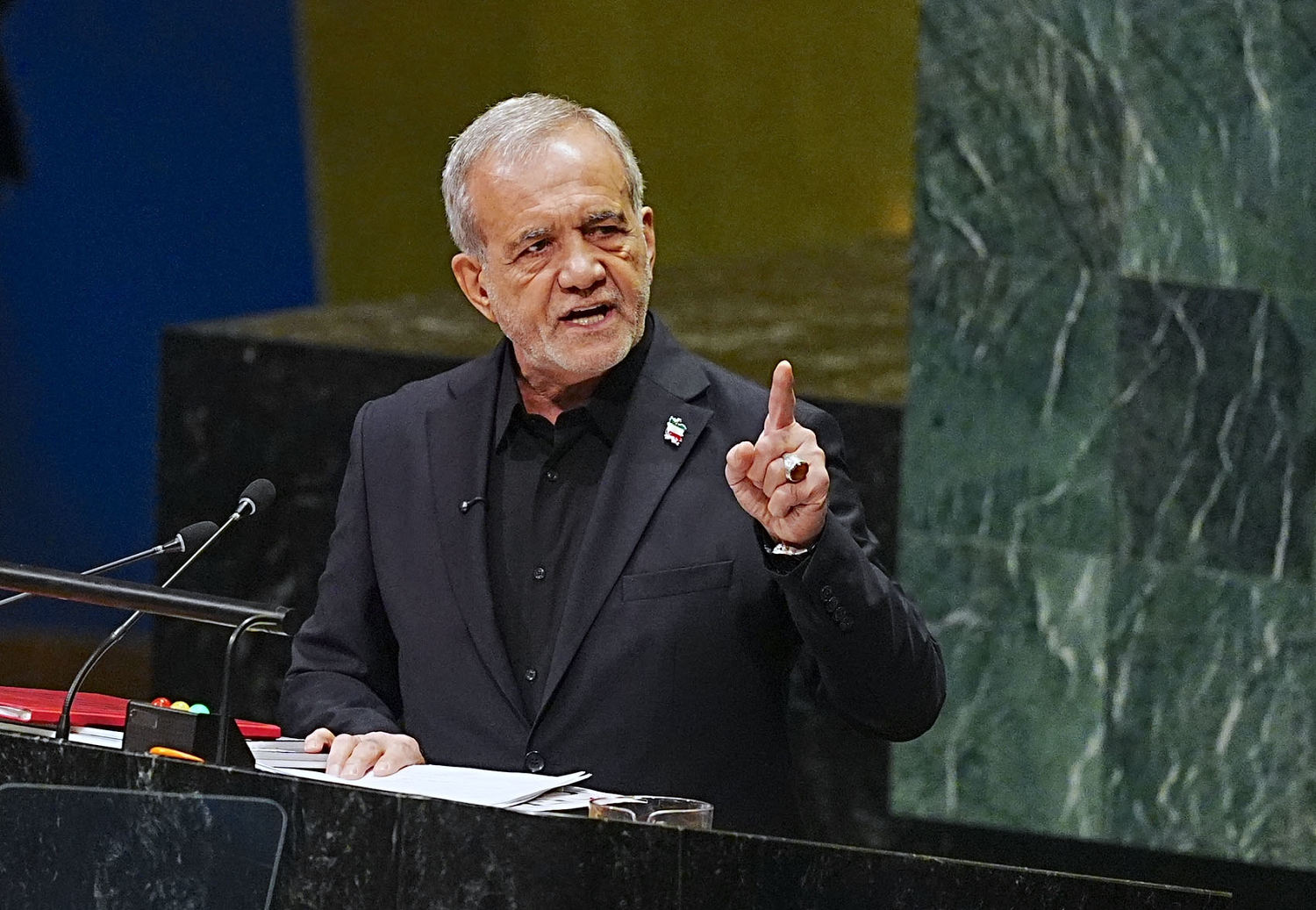
Iranian President Masoud Pezeshkian struck a defiant tone during his address at the United Nations General Assembly on Wednesday, the first time the leader of a country at war with the United States has addressed the world body. That is why we have the military power we do for defense,” he added. Pezeshkian also highlighted civilian casualties by holding up a picture of children killed when a U.S. munition likely hit an elementary school in Minab in southern Iran, NBC News has reported.
While the U.S. military has yet to directly accept the blame for the bombings on the first day of the war, experts commissioned by the U.N.’s top human rights body say they have found “reasonable grounds” to believe America committed war crimes in the strikes, which Iranian state media says killed 168 people, mostly children. A U.S. representative at the U.N. walked out as Pezeshkian mentioned civilian casualties, and many seats were empty during his address. Pezeshkian also displayed a photograph of Supreme Leader Ayatollah Ali Khamenei, who was killed when the Israeli military targeted his compound in Tehran on Feb. 28, alongside members of his family and senior Iranian officials.
Pezeshkian’s address followed Trump’s speech Tuesday, during which the American president threatened to destroy Iran. Or do I annihilate the Islamic Republic and do it quickly, never giving them a chance to kill and destroy people and countries again?” Despite his threat, Trump later told reporters that U.S. officials had a “very good meeting” with their Iranian counterparts Tuesday. U.S. envoys held indirect talks with Iranian officials and Qatari diplomats acted as intermediaries, according to a Middle Eastern official with knowledge of the matter.
The Qatari diplomats conveyed questions and responses from U.S. envoys Steve Witkoff and Trump’s son-in-law Jared Kushner to the Iranian officials, who then relayed their answers back via Qatar, the official said. U.S. delegation walks out of Iranian president's speech Pezeshkian also noted that further talks could be possible. Trump and those who seek to bully us that we are ready for dialogue and diplomacy and negotiations without accepting the language of force,” he said.
Trump also said during his U.N. address that there would likely be a deal with Iran after the U.S. midterm elections in November, though he did not provide any additional details. Pezeshkian defended Iran’s right to continue with its civilian nuclear program. Trump has repeatedly said that the goal of attacking Iran was to prevent the development of a nuclear weapon, which Iranian officials have said for years that they are not pursuing.
Soon after the war started, however, Iran blocked the Strait of Hormuz, a key waterway through which some 20% of the world’s oil flowed before the conflict, sending shock waves through the world economy. Iran and the U.S. signed a preliminary agreement, often referred to as a memorandum of understanding, in June aimed at ending the war and opening the strait. But heavy fighting broke out again over the summer, with Iran striking U.S. allies throughout the region.
Extract — continue reading at the source.