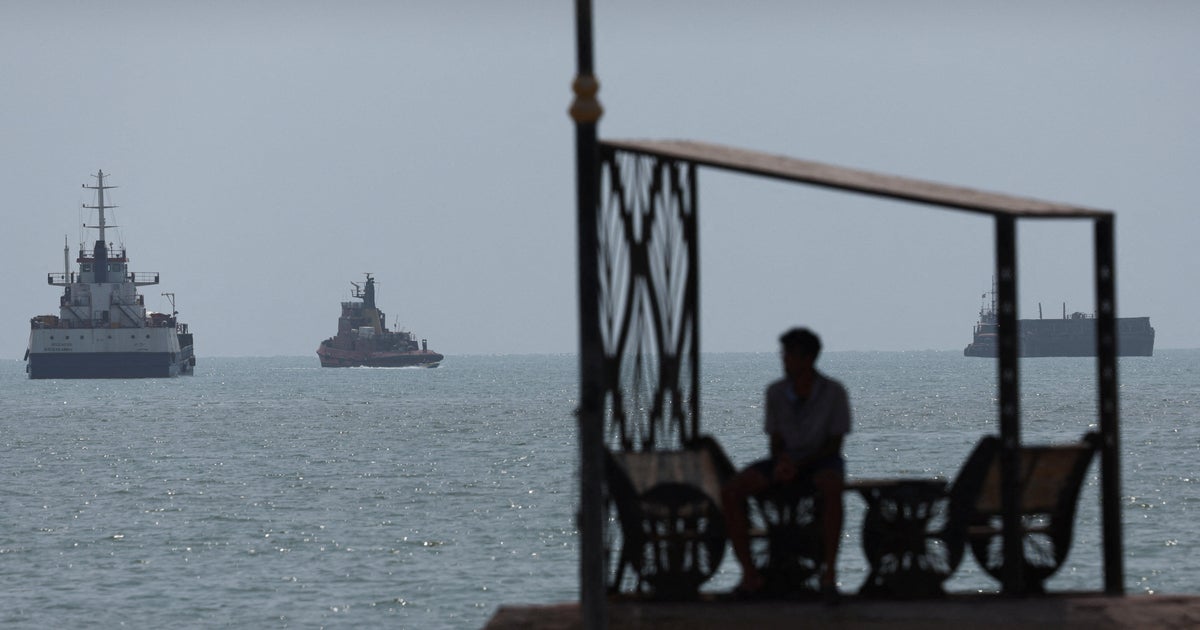
Brad Cooper, has echoed President Trump's insistence that the Strait of Hormuz shipping lanes are clear of sea mines, saying they are "open, and momentum is building." He acknowledged, however, that vessels still seek direct U.S. military protection to use the vital waterway, which Iran has scared many commercial shippers away from since the U.S. and Israel launched their joint war on Iran six months ago — driving global oil prices up by about 30% compared to pre-war levels. In a video statement posted online Thursday evening, Cooper said the U.S. military had "meticulously and quietly" cleared mines laid months ago by Iran's Islamic Revolutionary Guard Corps. "Internationally recognized transit routes in the strait are free of Iranian sea mines thanks to the incredible work of the U.S. military," he said.
"Today, international shipping lanes are open, and momentum is building." President Trump said Thursday that the U.S. helped 24 oil tankers transit the strait the previous night, reiterating his insistence that the waterway was de-mined, which he'd said several times before Cooper released his statement. But two dozen ships is a far cry from the roughly 120 that would typically transit the strait daily before the U.S. and Israel launched their joint war on Iran, and shippers remain highly wary of using the waterway given Iran's ongoing threat to vessels that risk passage without coordination with Tehran. Some U.S. allies have also said they do not believe the strait has been fully de-mined, according to a Thursday report by Bloomberg.
Regardless of whether mines still lurk in the water, Iran's threat to attack ships has kept traffic to a minimum. Even as he touted building momentum, Cooper acknowledged that ships still want direct U.S. assistance to make the passage, saying: "Over the past several months, U.S. forces have assisted nearly 1,500 commercial vessels in transiting the strait by providing coordinated protection." He said while the U.S. had enabled those ships to move 750 million barrels of crude oil out of the Persian Gulf, "Iran has exported zero barrels of oil from its shores since we resumed the naval blockade in mid-July." Iranian Oil Minister Mohsen Paknejad acknowledged on Thursday that the country's exports had "declined to some extent" - which is likely a significant understatement - but he insisted "the sale of our oil outside our territorial waters, in distant waters — meaning the delivery of oil to our customers — has continued," despite the U.S. blockade. Analysts note that Iran can also export its energy products over land, including to its most valuable trade partner, China.
Treasury Secretary Scott Bessent laid out plans this week for the "economic asphyxiation" of Iran, warning of dire consequences for countries that don't join the campaign. Iran's leaders, however, dismissed the impact of the new measures, having already endured decades-long crippling sanctions since shortly after the 1979 revolution. And analysts say a successful chokehold on the Islamic Republic would require cooperation from China — but that's unlikely.
Bessent told China to "get with the program," but Beijing instead has defended its cooperation with Tehran and vowed to safeguard its interests. Foreign Ministry spokesperson Lin Jian reiterated China's "firm opposition to illegal unilateral sanctions without the basis of international law and without authorization from the U.N. Security Council," adding that "economic warfare and extreme pressure do not help solve problems; they only further intensify conflicts, cause risks to spill over, disrupt the global economic and financial order, and harm the legitimate rights and interests of other countries." Lin said China's cooperation with Iran was "conducted within the framework of international law and should not be disrupted or undermined." Before the war, Tehran exported millions of barrels of oil a day, mostly to China.
Despite China buying less Iranian oil than it had been, the purchases remain an important source of revenue for Iran. Although most ship traffic in the vital Strait of Hormuz is still blocked and the U.S. is blockading Iranian ports, China isn't totally cut off from Iran's crude thanks to the highways and railways of Central Asia, said Sun Degang, a professor of political science at Shanghai's Fudan University. It's been six months since the United States and Israel attacked Iran with the perennial goal of transforming the Middle East through military force.
Extract — continue reading at the source.