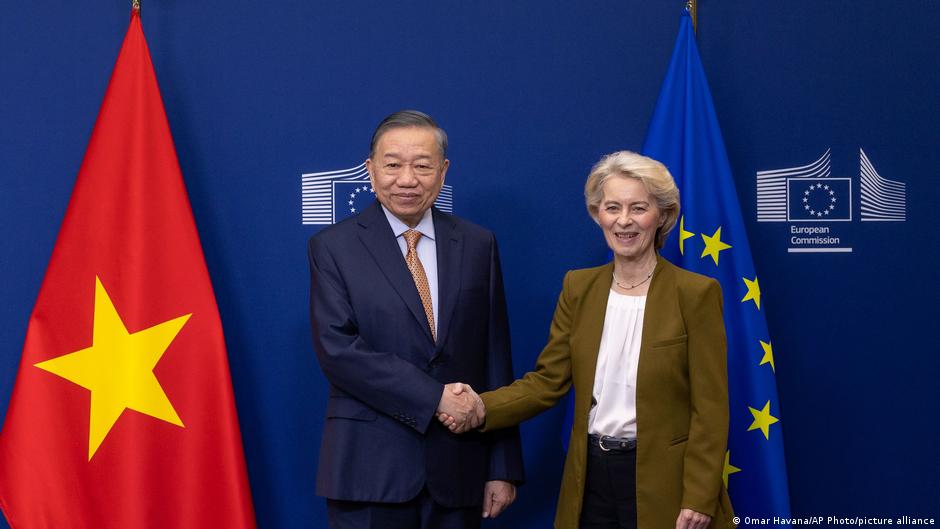
Vietnam's Communist Party chief and president, To Lam, arrived in Brussels on Wednesday for an official visit to the European Union (EU) and Belgium in another sign that relations continue to expand. The visit comes just days after Vietnam signed a free trade agreement with the European Free Trade Association (EFTA), comprising Norway, Switzerland, Iceland and Liechtenstein. Trade ties between Vietnam and Europe have deepened in recent years.
The EU-Vietnam Free Trade Agreement (EVFTA), which took effect in August 2020, substantially expanded Vietnam's commercial ties with most European states. Amid global tariff wars, the EU-Vietnam relationship "is a welcome advertisement for keeping markets open," Khac Giang Nguyen, a visiting fellow at the ISEAS–Yusof Ishak Institute in Singapore, told DW. "This is a win-win for both sides," he said.
"Vietnam offers Europe an established manufacturing base and another foothold in Asian supply chains. Europe offers Vietnam capital, technology and a large market, helping Hanoi reduce its exposure to American demand and Chinese industrial inputs." Vietnam is now the EU's largest goods-trading partner in Southeast Asia and its 14th-largest globally. The EU is Vietnam's fourth-largest trading partner and a major source of foreign investment.
Noneconomic relations are also advancing. In January, both sides upgraded ties to a Comprehensive Strategic Partnership — the first such agreement between the EU and a Southeast Asian country. Vietnam has become a key strategic partner for the EU in the Indo-Pacific, Alfred Gerstl, an expert on Indo-Pacific international relations at the University of Vienna, told DW.
"The cooperation is crucial for advancing the EU's economic security agenda and its strategy of de-risking from China," he said, referring to the European Union's efforts to diversify its supply chains and reduce dependence on Chinese manufacturing. Several EU states have signed defense agreements with Vietnam. Bloc foreign policy chief Kaja Kallas held talks with Vietnamese Foreign Minister Le Hoai Trung on Wednesday to discuss ways to improve security cooperation, including in the South China Sea, where Hanoi is locked in territorial disputes with China.
The relationship has also faced difficulties. Questions remain over whether European companies are benefiting sufficiently from Vietnam's economic boom and whether Brussels is overlooking Hanoi's worsening human rights record. Vietnam remains a one-party communist state that severely restricts political opposition, independent journalism and civil society.
Extract — continue reading at the source.