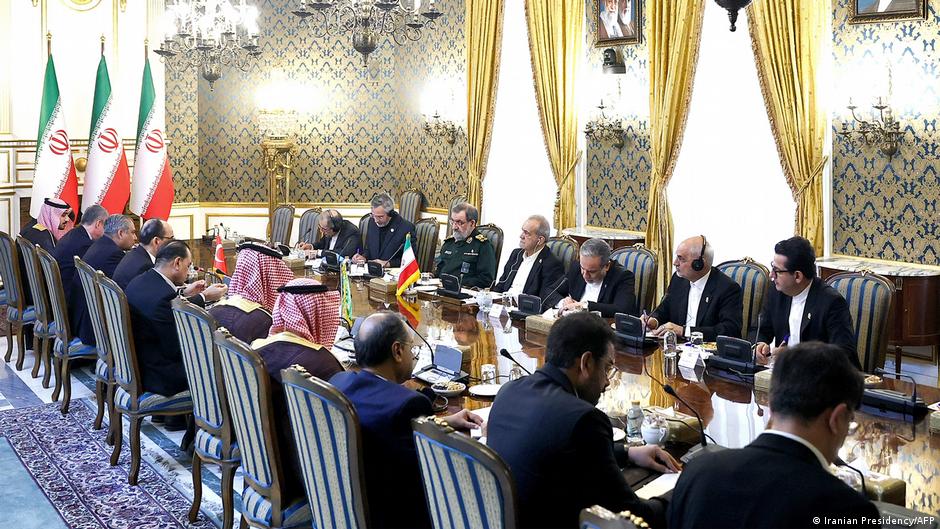
Amid rising fear that the US and Israel are preparing to launch new attacks on Iran after the US midterm election on November 3, three major Middle Eastern powers delivered a coordinated diplomatic message directly to Tehran. Pakistan's army chief Asim Munir, Saudi Defense Minister Khalid bin Salman and Turkish intelligence chief Ibrahim Kalin all traveled to Iran to meet Iranian President Masoud Pezeshkian and senior officials in Tehran this Monday. The three envoys serve as representatives for the Mecca defense pact — a military alliance of Islamabad, Riyad and Ankara, which was officially set up this summer.
Saudi Arabia said the trip aims to open negotiating channels and "prevent the return of military escalation." Details on the agenda, however, remain scarce. To view this video please enable JavaScript, and consider upgrading to a web browser that supports HTML5 video A senior Pakistani official cited by the news agency said the talks focused on building a regional non-aggression network, in addition to US-Iran talks, Houthi rebels' attacks on Saudi Arabia, the Strait of Hormuz and the US naval blockade. Another official said Pakistan's Munir presented Iran with a solution to the conflict that would offer something both to Washington and Iran, with the three Mecca states and Qatar acting as mediators.
The source told US President Donald Trump previously gave Munir the go-ahead to try diplomacy. Iran hailed the "very positive atmosphere" during the Tehran talks, even though no breakthroughs were officially announced. "Very good discussions took place between us," Mohsen Rezaei, head of Iran's Supreme National Security Council, told state television.
"I feel that a new atmosphere is emerging in the region." Rezaei argued that regional security should be built by countries in West Asia themselves and without outside intervention. A day later, Rezaei reportedly met Supreme Leader Mojtaba Khamenei. Iranian state media said Khamenei called for protecting Iran's interests and maintaining Tehran's conditions for ending both the war and the current state of "neither war nor peace." Meanwhile, Iran's President Masoud Pezeshkian travelled to Moscow for the Gas Exporting Countries Forum, where he met Russian President Vladimir Putin and Qatar's Emir Sheikh Tamim bin Hamad Al Thani, with Pezeshkian and the emir also discussing the war and the Strait of Hormuz.
These and other diplomatic contacts were framed by Tehran as evidence that the US is unable to diplomatically isolate the Iranian regime. The united front presented by the three nations in Tehran, however, can also be seen as a show of force for the new Mecca defense alliance. It comes as the Saudis grow increasingly wary of the attacks on Saudi infrastructure launched by the Iran-allied Houthi militants.
Under the terms of the Mecca agreement, an outside attack on one of the member states is to be regarded as an attack on all of them. The visit also came on the same day as Egypt's parliament agreeing to give military help to Ryad and take "all necessary measures" to help Saudi Arabia defend itself, in addition to the looming threat of the US and Israel. "The presence of the three senior representatives at the same time sent the message that these countries are acting as a bloc," Babak Dorbeiki, a London-based political analyst and former official at Iran's Strategic Research Center, told DW.
Extract — continue reading at the source.