As fears grow that the race for AI supremacy could be hurtling us all toward a grim fate not unlike the apocalyptic plot line of the Terminator movies, analysts tell CBS News that mutual distrust between the U.S. and China, as much as the technology itself, could lead humanity "off a cliff." The long-term fear among experts like the Anthropic researcher whose dire prediction stole headlines a week ago, is that superintelligence — a theoretical AI agent smarter than any person — could start to see humans as rivals for essential resources, endangering our survival. AI firms OpenAI and Anthropic have now called for a slowing of AI development, to "pace the frontier." China, the other major hub of work to push that frontier alongside Silicon Valley, has had its own warnings. A team of U.S. researchers last week used AI to expose a flaw in China's "app for everything" WeChat, which is used by more than 800 million people in the country.
Many Chinese firms agree with the growing consensus that AI must be regulated, according to Leia Wang, non-resident scholar at the Carnegie Endowment for Peace, who mentioned the Artificial Intelligence Laboratory in Shanghai as an example of a "highly reputable body" working on AI safety. Yi Zeng, the dean of the Beijing Institute of AI Safety and Governance, wrote in a research paper shared with CBS News that "the catastrophic risks posed by AI, and the hidden danger of human extinction, are growing by the day." Britain's King Charles III is to convene a meeting in Scotland on Thursday of industry leaders to discuss "whether a shared set of principles can be developed" to guide the future development and use of AI. Nvidia CEO Jensen Huang, whose firm is among those attending the conference, said in April that it was essential that U.S. and Chinese researchers "are actually talking." This bilateral coordination by industry leaders "is glaringly missing because of our current attitude about China as an adversary," he said.
A group of Democratic U.S. lawmakers have called on House Speaker Mike Johnson to delay the upcoming recess to get legislation passed on AI safeguards. Johnson said Sunday, however, that rushing regulations into law would mean the U.S. "will lose the race to China, and that is a threat to every single American." Republican Senator Ted Cruz said last week that "if there are gonna be killer robots, I'd rather they be American killer robots than Chinese killer robots." On Monday, President Trump dismissed warnings of an AI threat as a "sick conspiracy," adding in his Truth Social post that "the only one that is happy about it is China.
WHOEVER WINS AI, WINS!" "It's not that the U.S. government doesn't think AI is risky," Wang told CBS News, but that when it comes to U.S. leaders' "China-facing AI thoughts, the number one concern is technological competition." China's leaders have made some overtures toward collaboration on AI safety. In June, President Xi Jinping explicitly warned of the dangers of a "loss of control" of the technology. A month later he said countries must work together to "ensure that AI is always under human control." But like many senior U.S. officials, China's government has rejected calls to slow the pace of development, viewing the concept as an effort by the U.S.
"to assert its technological dominance," said Wang. After Anthropic CEO Dario Amodei said the U.S. and its global partners should collaborate "to keep democracies' AI lead over autocracies as large as possible, to give us the breathing room we need in order to pace effectively," China's Foreign Ministry said Monday that "narratives of threat … serve only to disrupt the process of global AI governance." Competition and mutual suspicion between the world's two biggest economies may come as little surprise, but Wang told CBS News that reducing the "AI safety conversation into a technological competition conversation" was "the most unhelpful framing," given the risks involved. In a February essay entitled "Who will save the world from a U.S.-China AI arms race?," National University of Singapore lecturer Alex Capri, an expert in trade and technology, wrote that the two countries "face a prisoner's dilemma … both would be safer with restraint, yet each accelerates development to avoid falling victim to the other." "A coordinated slowdown or grand international agreement might not be the right frame to engage Chinese firms and the government," Kwan Yee Ng, Head of International Governance at Concordia AI, an AI safety consultancy based in Beijing, told CBS News.
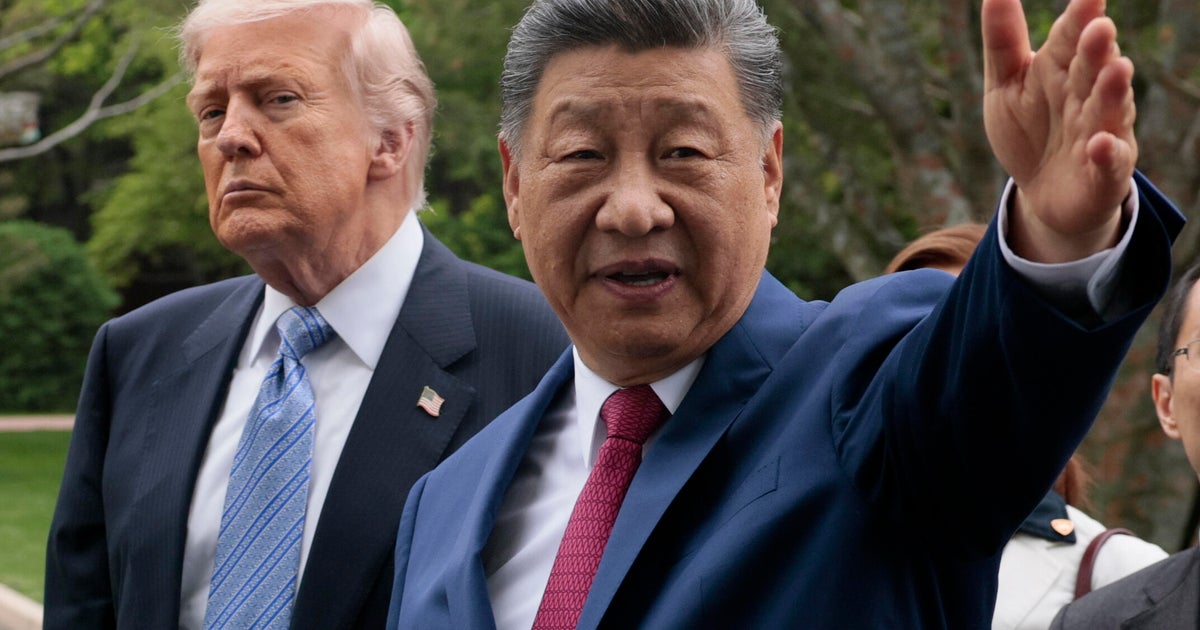
She added, however, that "there are many things the two countries can work on." That "low-hanging fruit," according to Ng, includes sharing cybersecurity best practices, coordinating to avoid any misuse of AI by terrorist groups or agents seeking to cause economic turmoil, and opening up low-level government talks to share granular technical information. Matt Sheehan, a colleague and fellow researcher of Wang's at the Carnegie Endowment, argues that another approach is "AI safety in parallel," which would see the two countries "move forward on parallel tracks, each advancing the technology and also acting to reduce the risks because they believe it is essential to their own national security — regardless of what the other does." China's government said after a May meeting in Beijing between Mr. Trump and Xi that the leaders had "agreed to hold dialogue between the two governments" on AI.
Extract — continue reading at the source.