Recent advances have expanded the role of lipid droplets (LDs) beyond passive lipid storage, implicating their involvement in various metabolic processes across mammalian tissues. Neuronal LDs, whose existence has long been debated, have now been identified in several neural structures, raising questions about their contribution to neurodegenerative disorders. Elucidating the specific chemical makeup of these organelles within neurons is critical for understanding their role in neural pathologies.
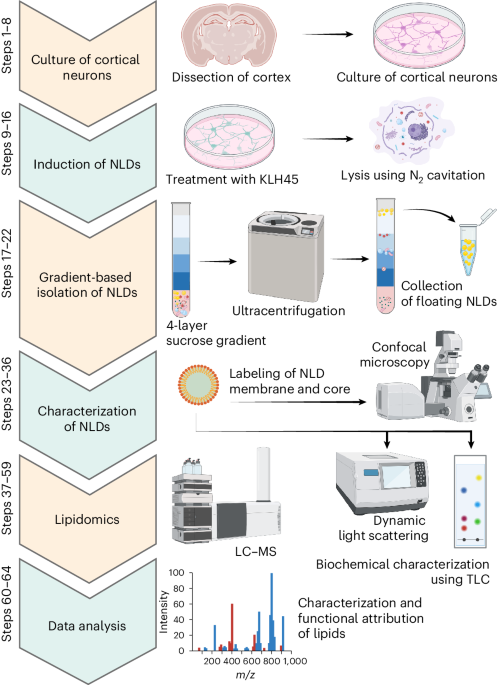
However, the inherent submicron size and low abundance in neurons have posed challenges in their isolation and physical and biochemical characterization. Here, we present our Protocol that overcomes this obstacle: we blocked neuron-specific triglyceride lipase to enlarge LDs, rendering them amenable to flotation in a sucrose gradient. We further used an improved methodology of lipidomic analysis on the LDs purified from cultured primary neurons, offering insights into their unique lipid composition.
This Protocol can be implemented by researchers with basic expertise in neuronal culture, imaging, ultracentrifuge handling and liquid chromatography–mass spectrometry analysis. The complete workflow requires 3–4 weeks, from neuronal culture to lipidomics analysis. Future integration of this method with high-throughput techniques holds promise for uncovering disease-specific alterations in lipid metabolism, providing new avenues for potential therapeutic interventions.
This Protocol describes a robust workflow for pharmacological induction, purification and characterization of mature lipid droplets from primary cortical neurons with minimal detected cytosolic membrane carryover. LC–MS analysis of neuronal lipid droplets can reveal lipids previously uncharacterized by other methods, providing a platform to integrate high-throughput proteomics and other techniques for probing neurodegenerative disease-linked metabolic alterations in neurons. This is a preview of subscription content, access via your institution Access Nature and 54 other Nature Portfolio journals Get Nature+, our best-value online-access subscription Receive 12 print issues and online access Prices may be subject to local taxes which are calculated during checkout The data, code, protocols and key lab materials used and generated are listed in a Key Resource Table alongside their persistent identifiers at https://doi.org/10.5281/zenodo.1787150856 and https://doi.org/10.5281/zenodo.2057514057.
The raw lipidomics files have been deposited to MassIVE repository (data set identifier: MSV000099675)58. All data cleaning, preprocessing, analysis and visualization were performed using ImageJ/FiJi software. An earlier version of this manuscript was posted to BioRxiv on Dec. 14, 2023, at https://doi.org/10.1101/2023.12.13.57152759.
Source data are provided with this paper. All Python scripts used for the lipidomic analysis and database generation can be found at GitHub repository (https://github.com/guptaMSlab/Lipidomics-Python-Quant-Protocol) or at Zenodo (https://doi.org/10.5281/zenodo.17496792)57. Lipid droplets finally get a little R-E-S-P-E-C-T.
Extract — continue reading at the source.


